Archive for the ‘Training’ Category

Stair running is an extremely demanding activity, and so it really pays to be wearing the right gear so you’re as comfortable as possible during your race.

Dressing for a stair race doesn’t differ much from any running event, but there are a couple of things unique to the sport that are worth considering.

Read on for a quick rundown of the key clothing decisions you should be thinking about ahead of your stair race.

Clothing

A lot of this would seem to be just plain common sense but you would be surprised what some people wear during stair running events. We have seen people labouring up the stairs in hoodies, jeans and boots. While these participants would obviously not be looking to win, or even compete, their clothing choices make for an altogether more uncomfortable experience than is necessary.

Keep things light and aim for comfort. Shorts and either a vest/singlet or a technical t-shirt made from some sort of wicking material will be best. Some stairwells can be a little chilly, but once you’re a few floors into your race, and whether you are walking or running, you are going to be heating up real quickly. Less is definitely best.

Shoes

Your regular running shoes will be just fine for a stair race. If you check out photos of elite runners at events around the world, most of them tend to have on pretty standard footwear. That being said, the recent upsurge in the popularity of minimalist footwear has found its way into the tower running scene too, and quite a few runners do favour light weight, zero drop shoes such as Vibram’s Five Finger range or the Merrell Trail Glove.

Some successful runners even race barefoot, with Americans Henry Wigglesworth and Paul Curley both preferring to run unshod.

Read our full in-depth guide on what shoes to wear for a tower race for more advice.

1912497_10100342405214606_1400867316_n

Sorry, what are those things you’ve got on your feet?

Some athletes will also wear compression socks, with the aim of saving their calves a little bit in the longer climbs.

Gloves

Quite often one of the first bits of advice novice stair climbers tend to hear from ‘experts’ is to wear cycling or weightlifting gloves, or more commonly, to wear one glove depending on which way the stairs turn. The suggestion being that they will allow competitors to grip the railing better and help produce a faster time.

The fact is the vast majority of elite stair climbers do not wear gloves and it’s really just a matter of preference. For example, Piotr Lobodzinksi, the reigning men’s tower running champion doesn’t wear gloves, but, Suzy Walsham the reigning women’s tower running champion does.

A set of gloves isn’t going to make the difference between winning and losing. If you have a pair already and you feel they are working for you in your training runs, and it gives you a bit more confidence then of course wear them on the day. But there’s no need to buy a pair especially for your first stair run.

Music and headphones

In global stair races, these are often allowed and used by competitors. They are more popular in the longer stair climbs, which last upwards of nine minutes, where the blast of some of your favourite psych up tunes can really help when you’re battling fatigue.

However, for health and safety reasons, most UK race organisers will not let you bring anything at all into the stairwell, so to bring or not to bring is not even a consideration.

Like us on Facebook for updates on results and upcoming events.
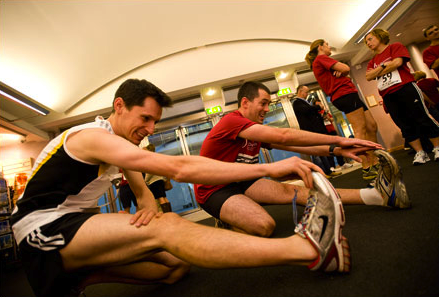
 

Mark Sims is likely the most successful British stair runner ever. He has chalked up wins at The Gherkin, Spinnaker Tower, The Great Yorkshire Stair Climb (Bridgewater Place, Leeds), Beetham Tower (Manchester), and was winner at The Royal Liver Building (Liverpool) nine years in a row. He has also had success abroad, finishing eighth at the Empire State Building Run Up, which is one of the showcase events on the stair running calendar. That top ten finish in among the world’s elite runners is arguably his most impressive performance.

During the build up to this year’s Towerrunning World Cup Final in Vienna, Mark kindly took some time out to answer a few questions about how he prepares for a race, what tips he’d give to a novice climber and what world tower he’d really like to run up.

mark sims10710718_10152736144428771_515644830187040573_n

What does a typical week of training look like for you as you prepare for a stair race?

I’m fortunate enough to be able to use the stairs where I work after 5:30pm so depending on family commitments I will try and train on them 2 to 3 times a week. I’ll do 3 to 4 timed ascents of differing lengths (either to target my speed or endurance), and to increase the intensity I use leg weights.

Away from the stairs I do some strengthening exercises, mostly squats of between 200-400 reps, as well as calf raises and sit-ups. I’ve also been trying to add a bit more endurance running by doing my local Park Run (5km) of a Saturday morning

Alongside this I’m cycling five days a week to and from work which exercises similar muscles.

What sort of technique do you use on the railings?

Depending on the width of the stairwell I’ll either use both sides or just the inside rail. I’m mostly using it to take some of the weight off the legs and also to help give me some kind of rhythm/pattern.

What key tips would you give to a novice stair climber preparing for their first race?

Know what you are up against. So have an idea of how long it will take you to cover the number of steps you are racing over. This will then allow you to focus your training better. I’d also want to tell them that during the race it may hurt on the way up, but the feeling that you get when you’ve finished is well worth it, and as they say, the pain is only temporary.

What race would you really like to do? or what global tower would you really like to run up?

The Torch in Doha, Qatar has held a race since 2012 and for March 2015 it will be the location of the world championships – I’d really enjoy being part of that.

What are your favourite and least favourite aspects of stair running?

I believe that if you make the training as hard as possible then the racing will be easier, so my favourite aspect would be the racing and the views you get from the top, and least favourite is pushing yourself in training.

Do you have any pre-races rituals?

None, but as a Christian I do like to pray before I race.

How do you tend to pace yourself during a race?

This made me laugh when I thought about it as if I were being brutally honest my answer would have to be badly, as my pace definitely slows the further I am into a race. However the plan is always to start off at a steady pace and get into a good rhythm and then push myself as hard as possible for the last quarter of the race.

What are the key qualities needed to succeed in stair climbing, and how can they be developed?

From a purely athletic point of view you need to be strong both physically and mentally, and the best way to develop these is practice. However, I’ve seen a vast range of people competing in stair running events for various reasons and success can be measured in so many different ways.

Like us on Facebook for updates on results and upcoming events.
Image

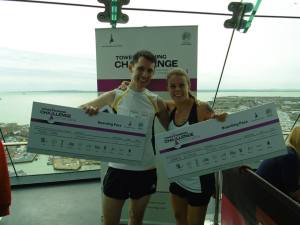
Kristin Frey is a vegan endurance athlete and elite stair runner from Illinois who came third in the 2013 Tower Running World Cup standings. She started her athletic career as a marathoner before transitioning into tower running in the 2010 season. She immediately began clocking up wins and has maintained her position among the world’s best stair runners for the last few years. She also has three top ten finishes in the Empire State Building Run Up (2011-2013), one of the classic events of the stair running calendar.

Last year, in the lead up to the NSPCC Gherkin Challenge, Tower Running UK got in touch with Kristin in order to get some insight into how the best tower runners train for an event. Kristin was very generous with her time and provided some great information about how she trains and her favoured techniques while powering up the stairs.

1. How do you pace yourself during a race?
“I usually try to start off conservative, or on the slower side, and pace myself during a climb. I will usually check my watch every 10-20 floors to see what kind of pace I’m on and I pick a “go-floor” where I tell myself to pick up the pace so I can finish strong.  I’m never actually running up the steps, some of the other top climbers can get away with that, but I usually take two steps at a time and its a quick walk.”

2. What sort of rail grip/technique do you use?
“I usually use the rail like a rope, so I’m pulling myself hand over hand.  I find that to be best for me.  Other climbers may use both rails if the stairwell is narrow enough and some of the top climbers may run up the steps barely touching the rail, but I prefer to stick to the inside rail.”

3. Could you give us an insight into your training regimen, e.g. sets, length of intervals, pace, alternating two step and one step runs?
My favourite training building is 20 floors, it takes me about 2:30-3:00 to climb depending on my pace.  Sometimes I will do 5 climbs using my normal technique and a fast pace, my rest will be the elevator ride down (usually about 3:00).  I will also do 5-10 floor sprints where I’m running steps. Whenever I’m doing a standard climb workout, I will always take two steps.

When I’m sprinting I will vary between one step running and two steps.  For sprints, I may do 5-10 floors then rest 1:00 then go again.  Maybe do 5-6 sprints. For cross training I do a lot of spinning and will also run on the treadmill with the incline set to 11-15%.  You could do intervals that will last the duration of your race, so 5:00 intervals if you think it’ll take you 5:00 to climb, etc.”

4. What one crucial tip would you give to a novice (but fit) stair runner to help them achieve a good time?
“I think the main thing is getting in some training in the stairwell so your familiar with it, and you can work on some technique.  Your heart rate will be high almost immediately and you’ll be breathing hard so start off conservative. Most people will start off too fast and then get tired after 5-10 floors!  It’s better to have extra energy and to pick up your pace along the way instead of crawling to the top”

If you can adapt some of these tips to your training schedule and be mindful of Kristin’s tip to pace yourself properly on race day, you stand a good chance of clocking a competitive time.

Tower Running UK would like to extend a massive thank you to Kristin Frey for her help and wishes her the best for the 2014 season, where she is planning to put most of her focus on ultramarathons. You can follow her progress at her blog: http://kristinfrey.blogspot.co.uk/

Like us on Facebook for updates on results and upcoming events.
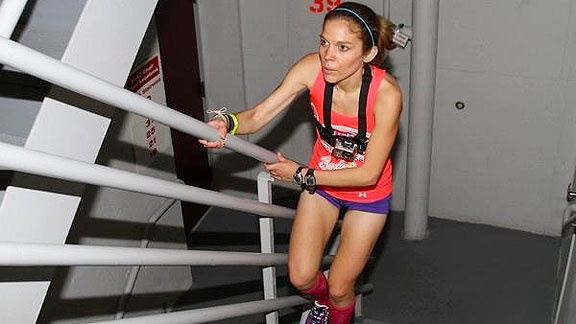
A short insight into the thinking and training of competitive stair runner PJ Glassey. PJ runs Seattle’s X-Gym, which helped forge a lot of the leading climbers in the USA.

“You have to have a screw loose to do tower running, and to be competitive you have to have a couple screws loose”

At the competitive level stair running success is mostly mental. After that the lungs are most important, followed by the legs, core and arms. Making sure you have trained all those elements well will go a long way to helping you achieve a good time.

Over the next few weeks we will be looking at these five aspects in more detail, and pointing you in the right direction so you can start to build strength in each area. For now we will touch upon them briefly to give you an idea of the direction you want to be heading in.

Arms: Just as with flat-level running, the arms are a vital tool in stair climbing. This may be in the form of pumping back and forth to drive you up each flight of stairs hands free or more likely it will be through using the banisters as an aid to your climb. We will have more on using the banisters to help you climb soon, but it’s generally used like a rope to help pull you up the stairs during the climb. To build the necessary strength and endurance in the biceps and latissimus dorsi (the muscles on each side of your back), you will want to work on rowing type moves. This can be done on a rowing machine, pulley rack, or seated rower in the gym.

Core: There are loads of exercises to choose from to target this area of the body and it’s really a case of taking your pick. The classic crunch is a good one to start with, but we will point towards some more advanced techniques in upcoming posts.

Legs: These get overloaded pretty early on in a stair race so it’s vital to have a good base of muscular endurance in them to ensure you stay strong right onto the higher floors. Squats and lunges (both can be done with or without weights depending on your existing fitness level) are the key exercises for great leg development.

Lungs: Assuming you have a solid base of cardiovascular fitness, we would recommend you begin incorporating some High Intensity Interval Training (HIIT) into your schedule to get used to pushing your heart and lungs hard. Tabata is one of the most popular forms of this type of training and we recommend you try it on an upright bike, rower or inclined treadmill for best results.

Mental: Your mind will always tell you to quit, stop or slow down before your body is really ready to. When the lactic acid burn really takes hold you will want to stop, but it’s vital you don’t. Pushing yourself past this point in training is a great way of building up the mental strength to handle pain during the event itself. If you want to be competitive then this is the element that will separate you from the rest.

Like us on Facebook for updates on results and upcoming events.