Tower running returned to the Eiffel Tower in 1906, as athletes from around France gathered to see if they could break the course record set the year before.
At the time, the Eiffel Tower was the tallest structure in the world, and on 26th November 1905 it had hosted what is believed to be the first recorded tower race in history. On that day, cyclist Eugene Forestier was the fastest up the 729 steps that led to the second platform of the tower. His winning time was 3:12.80.
A year on from that inaugural event and some of the best athletes from the French running and cycling scene arrived in Paris with one goal in mind; break Forestier’s record. Find out about the Eiffel Tower stair race of 1905, or read on for the story of the second edition.
Championnat de la tour Eiffel 1906
The second Eiffel Tower stair race took place on Sunday 18th November 1906. As it had been the year before, the event was organised by a publication called Les Sports.
Once again, the race involved running up 729 steps to the second platform (of three) of the tower. The reason they didn’t run to the top is the organisers felt the stairs on the upper levels were too narrow, and that it could have proved dangerous once the stairwell became crowded.
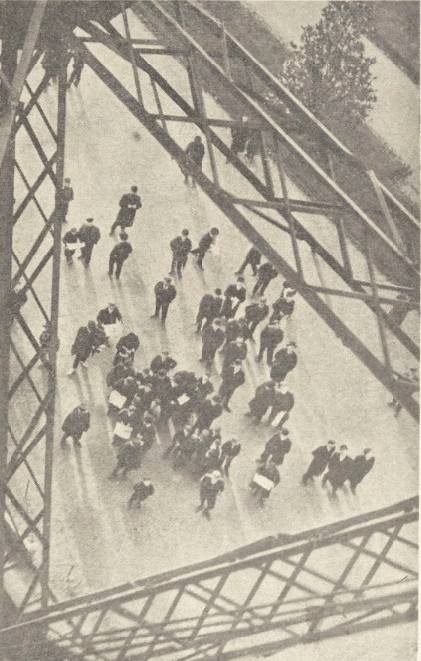
Crowds of spectators gather underneath the Eiffel Tower to watch the athletes run
Far less people signed up for the second edition than had attended the debut race. In 1905, 300 people had signed up, with 283 making it to the start line. This time around, 200 people signed up but only 140 (some reports say 150) eventually lined up to race.
Although there were fewer people in attendance, the quality of athletes was stronger. Back to defend his title was Eugene Forestier, the cyclist who had won the race in 1905 in a time of 3:12.80.
Joining him were a host of ‘champions’, although newspaper reports fail to specify exactly what they had won. But, further research has revealed at least some of the accomplishments of a few of those in attendance.
Among those listed as ‘champions of France’ were Eugene Neveu (a top long-distance runner, up to marathon distance) – L. Orphée (a cyclist), L. Mosnier and E. Fantou.
According to a report in La Liberté, the ‘Belgian champion’ Verstraete was also there. We were unable to find records relating to that name, but a François Verstraeten was a top level cyclist at the time, who had won the Paris to Ostend race in 1906 and went on to become the Belgian Road Champion in 1907 and 1908. It may be him they were referring to.
Louis Bouchard, billed as ‘champion of Paris’ was there, too. A year earlier, he had been the French record holder for the 10,000m with a time of 33:14, but that record had since been eclipsed by his great rival, Gaston Ragueneau.
Bouchard has finished second behind Ragueneau at the French Cross Country Championship in 1905 and 1906.
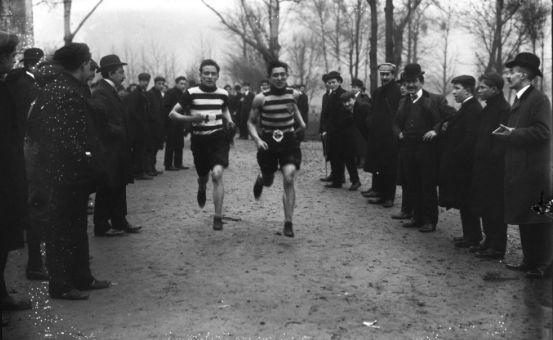
Louis Bouchard (l) and Gaston Ragueneau race for the finish line at the Challenge de La Nézière in 1905
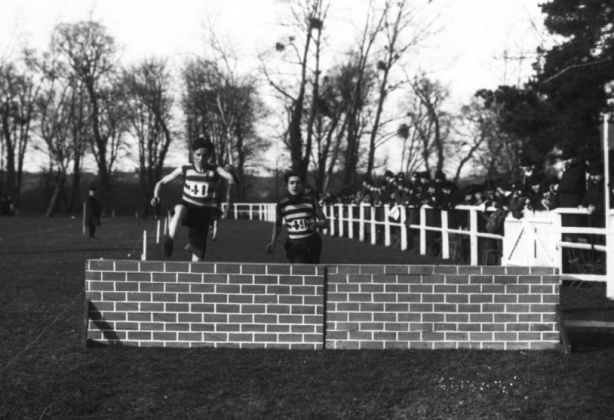
Louis Bouchard (41) in the lead (ahead of Ragueneau) at the Paris Cross Country Championship, 1905
Other runners and cyclists singled out for mention in the newspapers were Louis Prévôt, L. Mephisto, E. Figniez, Tonnin and Piel. Although some of these names pop up in race records from around the time, it’s been difficult to find firm details on any of these men.
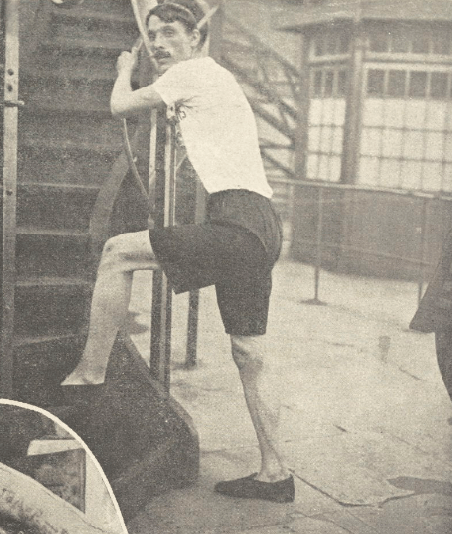
Champion cyclist, L. Orphée
The racers were split into different waves depending on which federation or category they belonged to. Category winners would receive a gold-plated medal, while second place would take home ‘an artistic medal’.
In the women’s wave, Mme. Baube was the only competitor to finish (or possibly even start) and won by default. She climbed the 739 steps in 7:44 (or 7:26 according to one report).
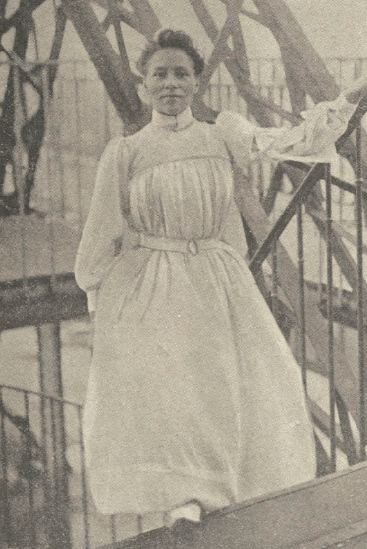
Mme. Baube, winner of the women’s division at the 1906 Eiffel Tower stair climb
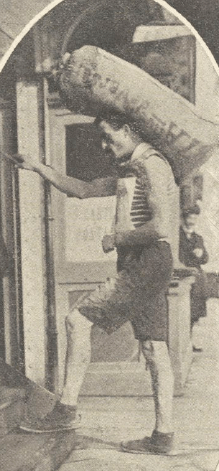
Finishing in around the same time as Mme. Baube was a Mr. Wachoru, who climbed all the steps in 7:37. The key difference being he did it while carrying a 50kg sack on his back.
Wachoru
In the Union des Sociétés Françaises de Sports Athlétiques wave, L. Frederick clocked 3:25 to win bragging rights among his fellow federation members. He was followed by Agogué in 3:43 and Ceroni in 3:50.
All eyes were on the wave of runners from the Union Vélocipédique de France, as among them was the 1905 winner, Eugene Forestier.
Unfortunately for Forestier, he was unable to repeat his triumph and had to settle for second place in his wave. Thiebaut finished in 3:18.40 and Forestier in 3:19.40. In third place was Chenot in 4:01.
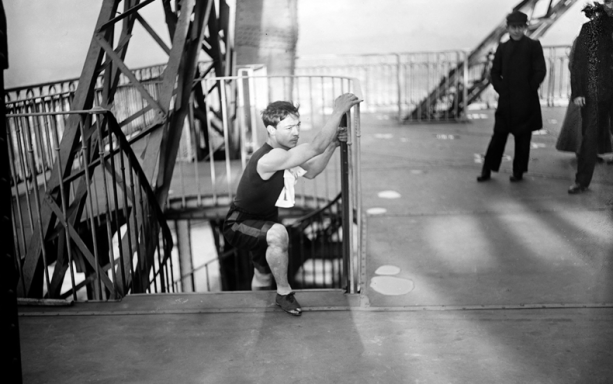
Thiebaut on his way to winning his wave
Next up were athletes from La Fédération cycliste et athlétique de France (FCAF). Fastest among them was Peuvrel, who clocked 3:56.20.
In the Indépendants category, a strong performance from J. Bielen saw him go into the overall lead, ahead of Thiebaut, with a time of 3:18.20. G. Lepage followed in 3:36.20, just ahead of Goulet in 3:37.60.
Apparently Bielen’s father was one of the people who painted the Eiffel Tower after the completion of its construction in 1889.
J. Bielen finished in 3:18.20
J. Bielen poses for a photo
With Forestier failing to clock the fastest time, he had to stand by and see if anyone in the Professionnels category might take the title ahead of Bielen.
Three members of the Club des Sports – L. Prévôt , L. Mephisto and E. Neveu – all finished ahead of Bielen and beat the previous course record.
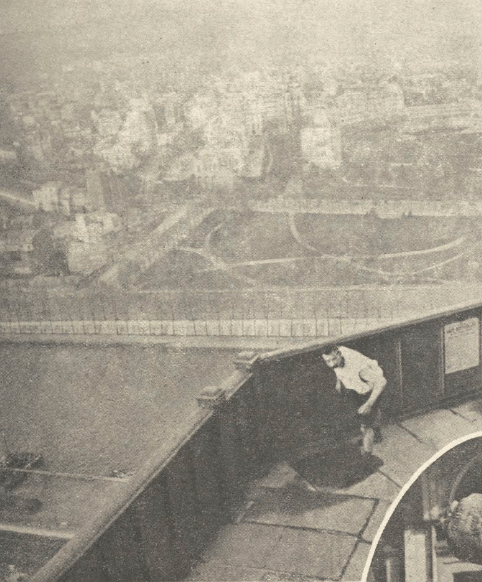
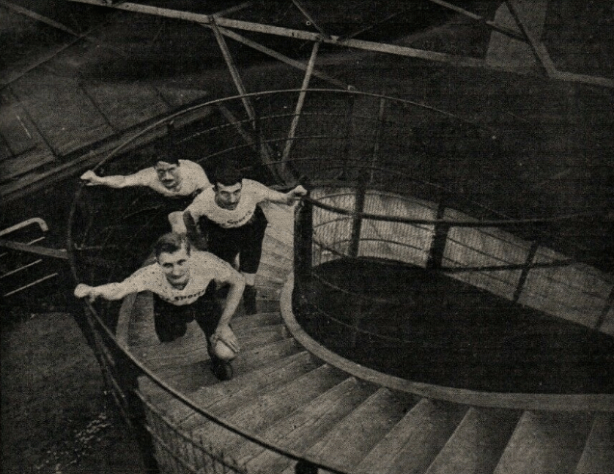
Orphée, Neveu and Mephisto (l-r) on the stairs of the Eiffel Tower
Club des Sports: Orphée, Mephisto and Neveu (front to back) pose for a photo (although it seems unusual that it’s not Prévôt alongside Neveu and Mephisto, the original caption says it’s Orphée)
Louis Prévôt finished in 3:12.40, beating the existing record by less than half a second. L. Mephisto then smashed that time when he reached the top in 3:04.40.
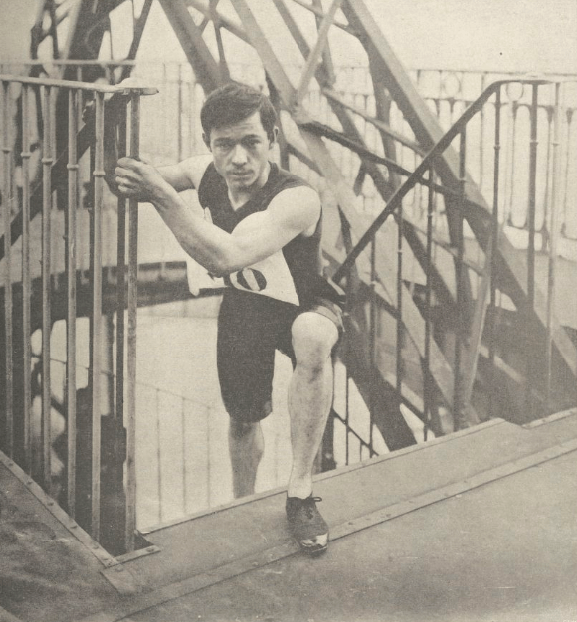
But overall victory went to the long-distance runner, Eugene Neveu. He won by the narrowest of margins with a time of 3:04 flat.
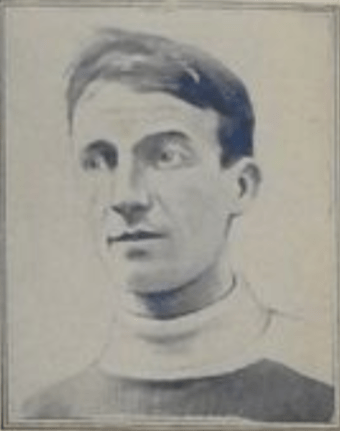
Eugene Neveu, winner of the Eiffel Tower stair climb 1906
‘Neveu’s time of 3:04 is simply wonderful, as it beats Forestier’s record by 8 seconds. We saw how much effort the victor had to produce to accomplish such a feat’, wrote one reporter.
Although 140-150 competitors lined up at the start, it was reported that only 93 completed the course. ‘A magnificent average’, according to one newspaper, ‘if one thinks of the effort that must be made to climb 730 steps in one go.’
If only they knew what the future held.
Championnat de la Tour Eiffel 1906 results (top six):
It’s hard to believe that Londoners have been racing up stairs for almost 290 years, but it’s true.
In 1730, a young man took on the challenge of running up and down what at the time was one of the capital’s tallest structures.
Read on to find out more about what surely must be the earliest record of competitive stair running.
The venue: The Monument to the Great Fire of London
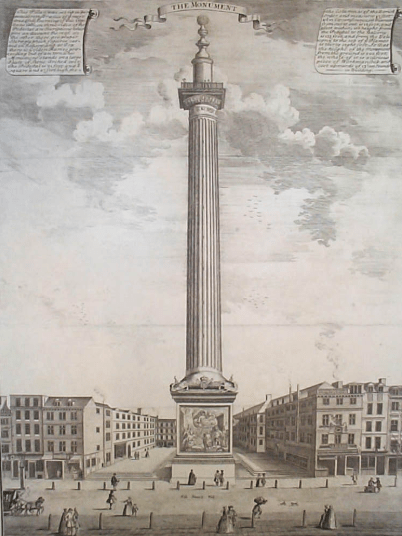
The Monument commemorates the Great Fire of London that happened in 1666. The renowned architect Christopher Wren (of St Paul’s Cathedral fame) worked on its design along with Robert Hooke, and construction began on it in 1671. By 1677, the 202 feet (62m) column was complete. It was positioned 202 feet from the spot where the Great Fire had begun on Pudding Lane.
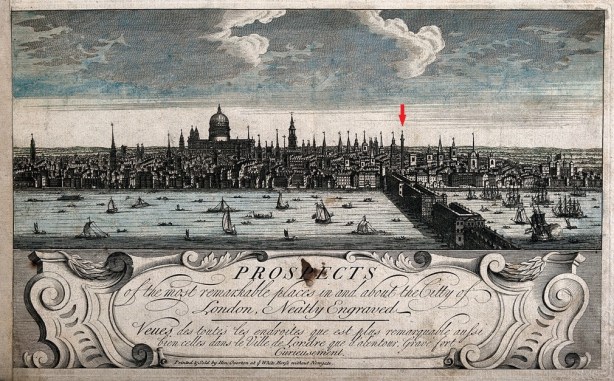
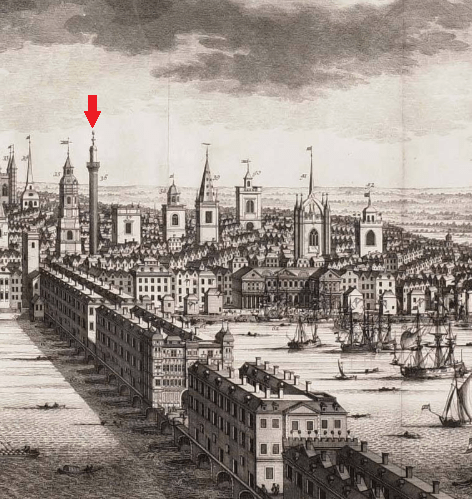
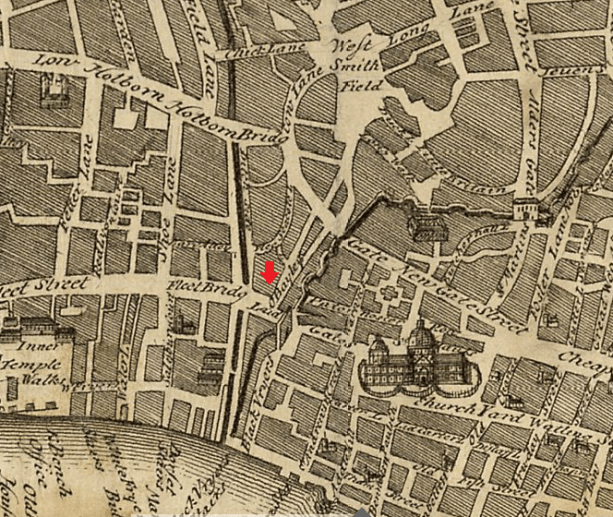
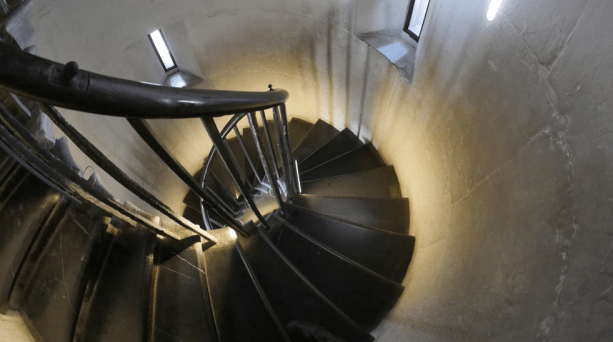
Inside, a narrow spiral staircase with 311 steps led up to a viewing deck at the top. You can see the Monument in the image below (highlighted by red arrow), just east of the old London Bridge.
An engraving of London made in 1730. The Monument can be seen to the east of London Bridge, highlighted by the red arrow.
A closer look at The Monument, taken from an engraving of the city of London made in 1710.
The Monument in 1753.
The wager: the Baptist Head Tavern, Old Bailey
On Thursday, 24 September 1730, a group of men sat in the Baptist Head Tavern, which was at the southern end of Old Bailey, the road most famously known for featuring London’s central criminal court among its buildings.
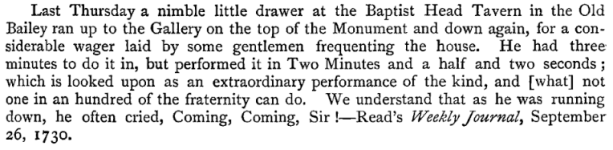
A small excerpt in the following Saturday’s (26th September) copy of J. Read’s Weekly Journal gives all the information we have about what transpired next, so some of the finer details remain unknown.
The Old Bailey (O Bayley) can be seen on this map from 1739. The arrow shows the approximate location of the Baptist Head Tavern at the southern end of the street, facing the courts.
The group made ‘a considerable wager’ among themselves, placing money on whether a barman (‘a nimble little drawer’) at the Baptist Head Tavern could run up the 311 steps of The Monument and back down again in three minutes or less.
The Monument is around a mile east of the Old Bailey, with an easy 20-minute walk getting you from one place to the other.
At The Monument, the speedy barman managed to complete the stair running challenge in just 2:32, which was deemed ‘an extraordinary performance’.
The narrow staircase inside The Monument.
Apparently on his way down the stairs he was shouting, ‘Coming, coming Sir’.
The actual copy from the Weekly Journal is reproduced below:
Although it wasn’t a ‘race’ as such (though still a race against the clock), this is now easily the earliest example of stair running for sport we’ve seen. It pre-dates the earliest proper stair race in Paris in 1903, by a massive 173 years.
Earlier this year, The Monument made good promotional use of this historic event to challenge visitors to beat the record of the ‘nimble little drawer’.
The venue tends to be fairly busy at all times of the day, so getting a clear run up and down is very unlikely. But you can enter the site every day from 9.30am for £4.50 to give it a shot. More info available on The Monument website.
Home to some of the biggest races in tower running, Asia is fast becoming the main arena of the sport. But stair running is nothing new to the region – Singapore has been hosting races for over 30 years.
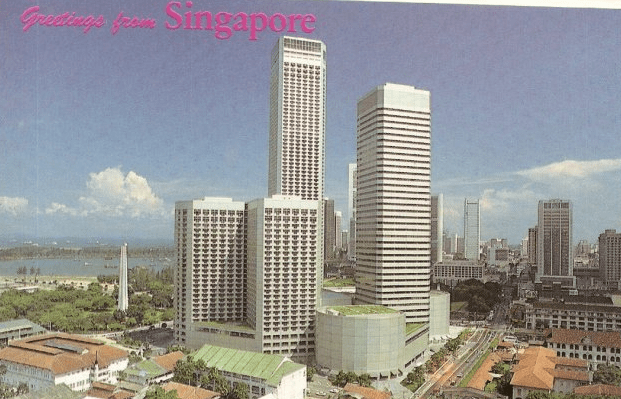
Swissotel The Stamford hotel in Raffles City, Singapore is famous in the lore of tower running, most notably as the venue for the stair racing debut of the incredible Suzy Walsham in 2006. But the Australian superstar’s first race at the Vertical Marathon was actually the 20th edition of the event.
Read on to find out how the Asian tower running scene began in Singapore in 1987.
Back in 1987, the now Swissotel The Stamford was part of the Westin chain of hotels. William McCreary was managing director of Westin Stamford and the nearby Plaza, and under his stewardship the two hotels jointly designed to organise the first stair race event in the region.
As the tallest hotel in the world at the time, the 226-metre high Stamford was selected as the venue for the event. With 1,336 steps spread over 73 floors, the building would prove quite a challenge to the first time runners in Singapore.
All the funds raised by the ‘Vertical Marathon’ would go to the Community Chest, which had been established in 1983 to raise funds for social welfare projects in Singapore.
The trial run
Practice sessions in buildings hosting tower runs aren’t unique and nowadays a number of large events, particularly in the United States, grant participants access to the stairs weeks in advance of the race.
But the Vertical Marathon in 1987 was slightly different in that it appears to have officially timed the trial run, which was held in February a full three months before the big race in May.
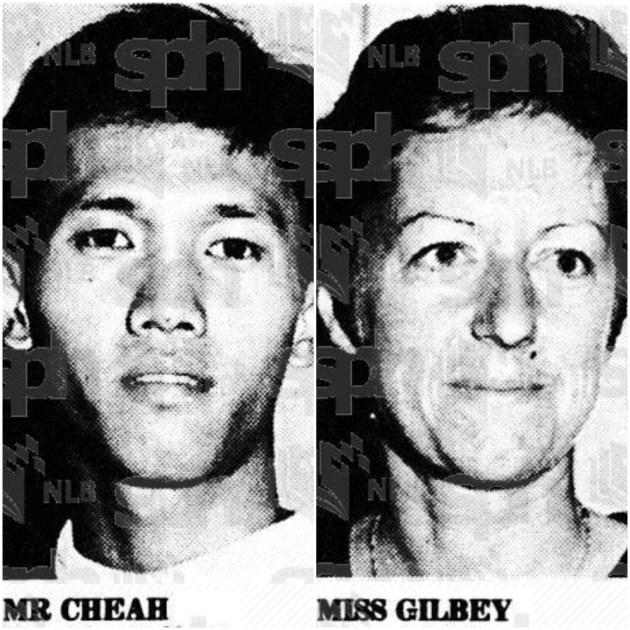
The fastest man and woman at the trial run even got their pictures in one of the biggest English-language newspapers in Singapore, The Straits Times.
David Cheah Fook Choy, a 25-year old technician with the Public Utilities Board, was fastest to the top with a time of 8:20.
Mr Cheah said he was exhausted after the first 40 floors and had to walk the remaining 33. ‘But the heavenly view you catch at the top of the building makes it all worth the while’, he added.
The fastest woman in the trial was a 31-year old British athlete, Helen Gilbey, a lecturer at the College of Physical Education. Already a well-established athlete in Singapore with a number of road races of varying distances under her belt, Gilbey finished with a trial time of 10:05.
‘After running 50 floors, oooh! I had to pull myself up using the safety banisters’, she told reporters.
The pair would head into the main race as firm favourites.
Vertical Events Sports Association
Before the main event had even taken place, an industrious group had got together and formed the Vertical Events Sports Association (VESA). The stated aims of the association were to promote and organise ‘all forms of vertical sport, including climbing steps or walking and running up high buildings’.
The Association was met with incredulity. It took six months for the Registrar of Societies to sign off on it – double the usual length of time it took to register a new association.
But Kenneth Jalleh, President of VESA, was determined to show this was no joke. ‘In no way are we going to try and push this as a fun thing. This is serious’, he told reporters. ‘Nobody realises just how good an exercise this is. It’s aerobic, it builds up a lot of strength and it’s dirt cheap’.
‘And we’ve got some of the tallest buildings in the world and most Singaporeans live in high-rise buildings’, added honorary secretary Kelvin Tan.
Jalleh also referenced the growing popularity of the sport in the USA and said that in 1986 a stair climb event at the World Trade Center had attracted 26,000 participants (Ed. note – this number seems almost impossible and we’ve been unable to find additional references to this event happening).
A public health warning
A little under a month before the race took place, The Straits Times carried an interview with two doctors, under the headline – ‘Vertical run only for very fit’.
The pair advised that those thinking of taking part in the upcoming Vertical Marathon should be very fit and train for the event.
Dr Low Lip Ping from the Singapore National Heart Association said: ‘I would not recommend anyone to take part in such an event as stairs racing, because it gives the person little chance to warm up and thus cause the blood pressure to go up too fast.’
Dr Giam Choo Kiong, Head of Sports Medicine and Research at the Singapore Sports Council added: ‘Running up stairs has been shown to be up to three times as strenuous as running on the level. Therefore, running up stairs continuously is not recommended for people who are unfit or do not train for such an activity.’
By this point, less than four weeks out from the race, 100 people had already signed up. They did so by picking up an entry form from the HR departments at either the Plaza or Stamford hotels.
The first Singapore Vertical Marathon
On Sunday 3rd May 1987 the first Singapore Vertical Marathon took place. 180 of the 250 available spaces had been filled, with 130 men and 50 women at the start line.
Participants had to be between 16 and 40 years old and each was asked to raise at least $73 – a dollar for each floor of the hotel they would be running up.
The prize for the fastest man and woman was a two-night stay at the Executive Suite of the Westin Plaza with American breakfast included, plus a year’s free membership at Raffles City Health Club.
The event got underway at 9am, with batches of four runners setting off every two minutes. Officials from the Singapore Amateur Athletic Association acted as marshals, timekeepers and recorders.
Spectators were gathered on the ground floor of the hotel to follow the action. Seven cameras had been set up at various points throughout the stairwell to relay the event live.
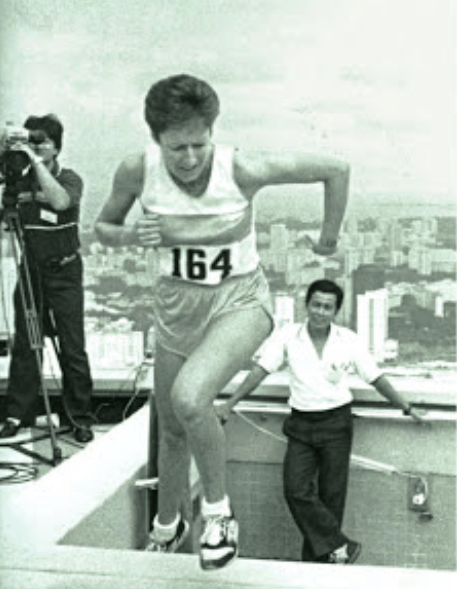
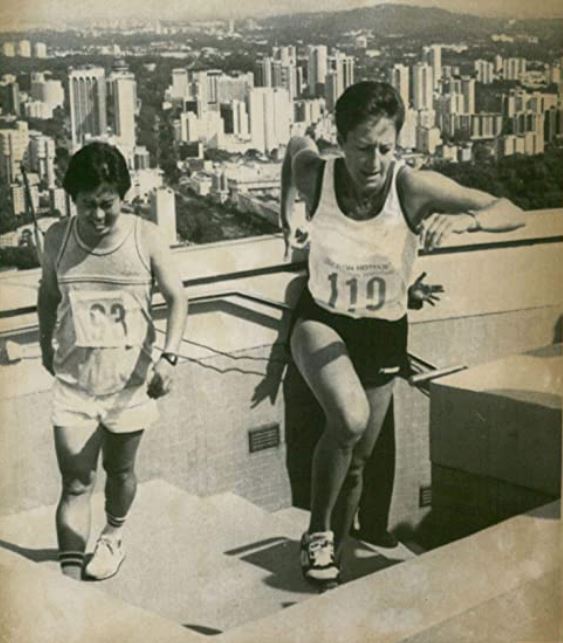
With her marathon-running background and strong trial run time of 10:05, Helen Gilbey was favourite to take the win in the women’s division. She told reporters she was hoping to finish in under 9:30. Gilbey did even better than anticipated, reaching the rooftop finish in 9:04.
Helen Gilbey exits onto the rooftop of the Stamford hotel to win the first Singapore Vertical Marathon in 1987
Leong Siew May finished second in 10:25, and Tan Meow Liang was third in 10:41.
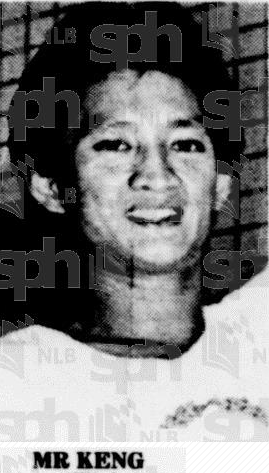
In the men’s race, Kenneth Keng took victory in 7:20. A successful athlete for a number of years, Keng had won the Singapore triathlon from 1983-1985.
He edged out the February trial run winner David Cheah who finished in 7:47. Another triathlete, Martin Hagger, finished third in 8:12.
Keng told reporters that the race was ‘grueling’, but that he’d do it again next year.
The organisers put forward Kenneth Keng’s and Helen Gilbey’s name to the Guinness Book of Records, and apparently Keng was listed in the 1987 edition.
The whole event raised $20,000 dollars for the Community Chest of Singapore.
1988 Singapore Vertical Marathon
Both 1987 winners returned on Sunday 8th May 1988 to defend their titles.
Kenneth Keng secured victory in a time of 7:35.
‘I went too fast in the beginning’, he said. ‘I should be very happy with the time as I’ve just recovered from the flu.’
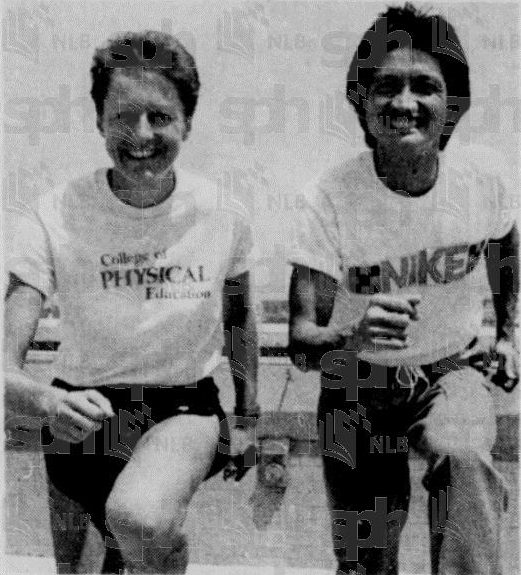
Helen Gilbey said before the race she was aiming to finish in ‘anything under nine minutes’. She did just that, setting a new course record of 8:46.
‘I’m very pleased, and very relieved it’s all over as well’, said Gilbey. ‘My husband and I live in a 14-storey apartment block and we have been running nine times up the stairs three times a week. This has been going on for the last six to eight weeks.’
Helen Gilbey and Kenneth Keng celebrate winning the 1988 Singapore Vertical Marathon
20 years before La Verticale de la Tour Eiffel started in 2015, there was a one-off race up the stairs of the Eiffel Tower.
On Sunday 3rd December 1995, 75 runners lined up to race up the 1,665 steps of the iconic Paris landmark.
The start list was packed full of many of the best French athletes of the day.
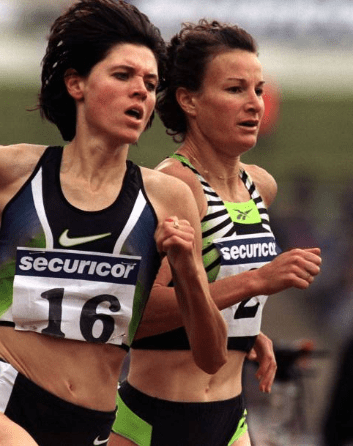
In the women’s race there was marathoner Irina Kazakova, plus the newly crowned French 1500m champion Frédérique Quentin, who’d also won the national championship in 1992, and would go on to defend it from 1996-1998.
Frédérique Quentin (#16) racing with Sonia O’Sullivan
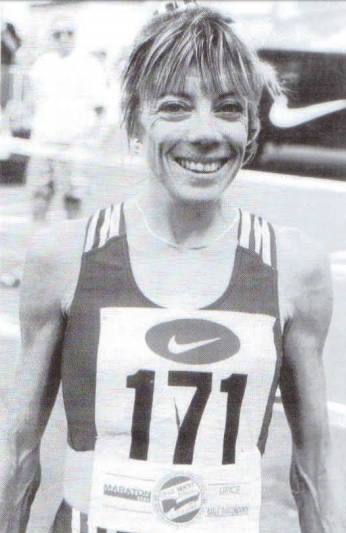
The brilliant mountain runner Isabelle Guillot was also there. Guillot had won the World Mountain Running Championships in 1989, 1991 and 1993, and had finished second in 1994 and 1995.
Isabelle Guillot
In the men’s division there were the triathletes, Xavier Galea and Yves Lossouarn, plus mountain runners Eric Lacroix and Jean-Paul Payet, who was second at the World Mountain Running Championships in 1991 and 1992.
Yves Lossouarn took victory in the men’s race with a time of 8:51, while Irina Kazakova was the fastest woman in 9:56.
It’s 54 years since the first fully-recorded stair race in the UK took place in April 1968 at the GPO Tower (now BT Tower).
Although an undocumented event involving London students took place the year before, 1968 serves as a key point in the sport’s history in this country. We take a look back through the archives, and chat to some of the participants, to find out more about that historic and trailblazing race.
Read on to find out more about the sport’s history in the UK, including who took part in that race in 1968 and what the winning time was.
The GPO Tower
The tower had been commissioned by the General Post Office to support microwave aerials carrying telecommunications transmissions from London to the rest of the country. Work began in June 1961 and was finished in July 1964, at a cost of £2.5 million.
The tower under construction in 1963.
Upon completion the tower became the tallest building in the UK – a title it would hold until the completion of the Natwest Tower (Tower 42) in 1980.
It wasn’t until October 1965 that it would officially open, in a ceremony with then Prime Minister Harold Wilson in attendance.
Prime Minister Harold Wilson officially opening the tower, with former Prime Minister Clement Atlee (seated) and a young Tony Benn watching on.
The first documented tower race in the UK
The race took place on Thursday 18th April 1968. It was organised by students from nearby University College, London as part of the RAG Committees activities that year. RAG is a longstanding, and still popular, tradition at UK universities, where students engage in a variety of activities, including sports events and sponsored challenges, to raise money for charitable causes.
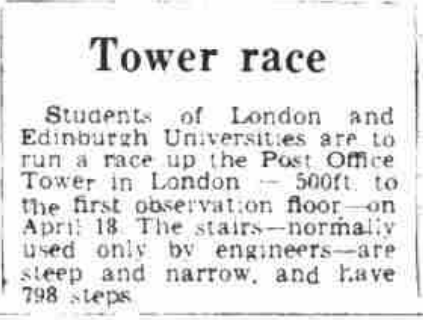
The small piece pictured below featured in the Aberdeen Evening Express on Wednesday 10 April 1968, just over a week before the event.
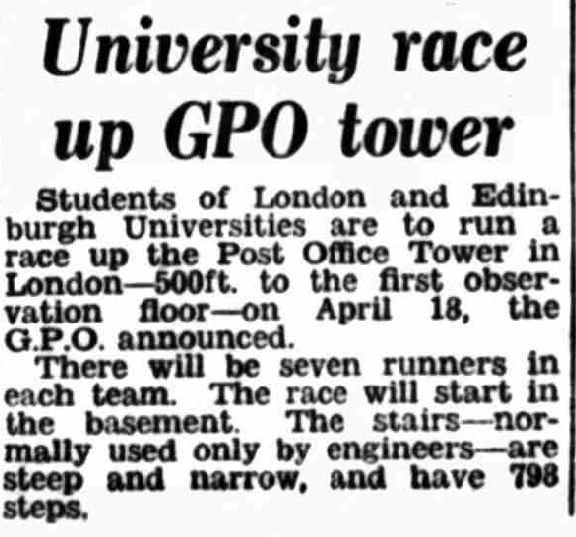
The next one is taken from the Coventry Evening Telegraph on Friday 12th April 1968.
Details about who was involved at the University of London, and how they managed to organise the event, have proved hard to come by. But we do know an invite/challenge was extended to students at the University of Edinburgh, who tied it in with their own Charities Week initiative up there.
By the time the event finished, the Londoners may well have regretted their choice of competition. Edinburgh sent down a team made up of members of the athletics and cross-country teams. They were among the best athletes in the country at the time.
Earlier in 1968, the University of Edinburgh Hare and Hounds cross-country team had won the British Universities Cross Country title. They had also won the team title at the Scottish National Cross Country Championship, becoming the first and only university team to have done so.
The Edinburgh team that attended the event was made up of: Hugh Stevenson (high hurdles), Jack MacFie (800m and cross-country), Iain Hathorn (400/800m and cross country), Andy McKean, John Exley and Ken Fyfe (all cross country). Also in attendance was Sheila Duncan, the only woman racing on the day.
The Edinburgh University team celebrating their success
The seven-person Edinburgh team completely dominated the event. The men filled the top six places on the leaderboard, with cross-country athlete and 800m track specialist Jack MacFie taking the overall win, and establishing the course record, in a time of 4.46.
The previous record, set in 1967 by an unknown University of London student, stood at 6.02.
Behind him were Andy McKean (4.59), Ken Fyfe and Iain Hathorn (5.10), John Exley (5.32) and Hugh Stevenson (5.35).
The six men of the University of Edinburgh team (note – our name spellings are correct)
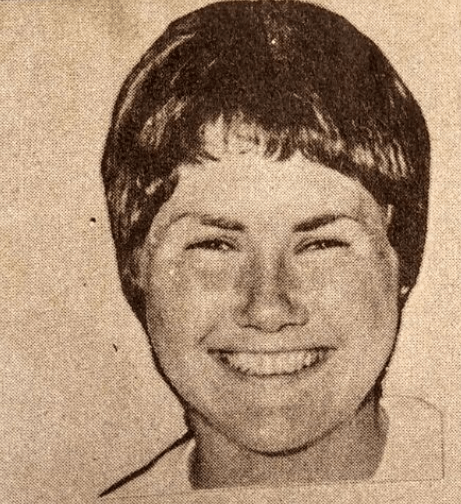
Sheila Duncan finished in a time of 7.06. She was a multi-eventer on the university’s athletics team, but was better known as a hockey player who went on to represent the Scottish national team.
Sheila Duncan
Memories of the race
We got in touch with Andy McKean, a first year architecture student at the time, and team mates John Exley and Hugh Stevenson, to find out what memories remained of that race over 50 years ago. Following the event, Andy went on to win four Scottish Cross Country titles, represented Scotland at international races, and competed in the inaugural World Cross Country Championship in 1973.
“I think our participation may have been in some way associated with the Edinburgh Charities Week – i.e as a kind of charity stunt. I recall receiving a t-shirt emblazoned with the GPO Tower and a charity name, although I cannot remember which one. It must have been organised rather at the last minute and on a shoe string: we all traveled down by car the night before (fortunately with other friends driving), and back to Edinburgh again overnight the night after; so I was absolutely knackered when we got home!”
Remarkably, Hugh Stevenson still had his 50-year old t-shirt when we heard from him. He told us the team had been sponsored by the Scottish Milk Marketing Board in aid of Edinburgh Student Charities, and the t-shirts had ‘Edinburgh Charities Strong Pintamen up GPO Tower’ written on them.
For those of you who have raced the BT Tower in recent years, you will recall how narrow the stairwell is. A problem that hindered McKean on the day:
“In truth I was a bit too tall for it, as the space was fairly confined and actually felt quite claustrophobic at times.”
But he recalls the victorious Jack MacFie was well suited to it:
“Yes, Jack was indeed the fastest on the day, and I remember us all reflecting afterwards that he had exactly the right build for the event, slightly stocky (by distance running standards) but sufficiently strong and agile for managing the steps and turns at the stair landings.”
Yes, those pioneers immediately recognised the importance of quick landing turns to success in stair running.
There was lots of media coverage on the day from newspapers and national TV, including the video below.
Hugh Stevenson recalled well-known TV presenter Alex Mackintosh interviewing race winner Jack MacFie.
“‘Well Jack, now that you’ve got your breath back, how does it feel to be World All Comers Record Holder for the Post Office Tower?’. To which the reply was, ‘All right I suppose.’ The nightmare continued with, ‘How are the team going to celebrate your victory tonight?’ Jack replied, ‘Have a few drinks I suppose, then drive back up to Edinburgh’ Cue panic cries from producer, ‘Cut! Cut! Can’t have that!’.”
Despite the large amount of media coverage on the day and the morning after, we found it hard to get hold of, with practically all of it kept behind the pay walls of multiple archive search engines. But thankfully, Hugh shared with us several newspaper clippings from the event he had in his scrapbook.
Thigh and mighty: the imposing Edinburgh team
Funnily, one journalist commented:
‘In years to come the Tower Race could take the place of the old-styled boat race between Oxford and Cambridge.’
52 years on and disappointingly nothing close to that has materialised, and the sport in the UK is still very much in its infancy in terms of numbers of participants, media coverage, recognition and respect.
GPO Tower race 1969 and 1970
The organisers managed to run the event again in 1969, expanding it to include students from eight universities, but without the participation of the University of Edinburgh.
John Pearson of Manchester University was fastest in 1969, reaching the top in 5.07.
1970 would be the last year this University of London-organised event took place. Scottish athlete Norman Morrison, at the time a mathematics student at Imperial College, won the event and set a new course record of 4.21.
The only woman at the event that year was Hilary Tanner, representing Hull University. Like the fastest man at the race, she also set a new course record, with her time of 7.00.
An IRA bomb at the BT Tower in 1971 led to its closure to the public, and the event never returned. Unfortunately, it would be decades before tower running returned to anywhere in the UK.
In the intervening years the sport took off in North America, with the 1978 Empire State Building Run-Up being the first event, and now the longest continuously running stair climb event in the world.
The effort you need to ascend you can not find in any other sport. It is purely athletic, because it demands from the champion as much strength as speed and as much agility as endurance – Le Journal
The sixth edition of La Verticale de la Tour Eiffel will hopefully take place in 2021. Among the racers set to take part will be the reigning world champions, Piotr Lobodzinski and Suzy Walsham, who’ll be aiming to make it six wins in a row in Paris.
With its narrow field of participants and, of course, its iconic venue, entrance to La Verticale is one of the most sought after in the tower running calendar.
Tracing its origins back as far as 1905, the Eiffel Tower stair climb is probably the world’s oldest tower run, although the first organised stair climb goes back a couple of years before that, when an outdoor stair race was held at Rue Foyatier in Paris 1903. You can read about that event here.
Combining reports from multiple newspapers and magazines from 1905, this is the most detailed account of that first race at the Eiffel Tower.
Le Championnat de L’Escalier 1905
Organised by a magazine called Les Sports, the race took place on Sunday 26th November 1905. It was a cold day with very heavy rains and strong winds. Yet despite the bad weather, large crowds gathered at the foot of the Tower, and on the platforms on the way up, to witness this ‘unique spectacle’.
This comes as no surprise. At the time, the Eiffel Tower was the tallest man-made structure in the world, with the longest staircase. Those in attendance were witnessing history.
Newspaper Le Journal said ‘Les Sports had the unique idea to have athletes from all sports battle it out on a new ground…the stairs.’ The magazine’s aim was to pit champions and elite athletes from various sporting traditions against each other in the ultimate test of fitness. Runners, cyclists and footballers were all among those who took part in the event.
Of the 300 entrants who were due to attend, 283 made it to the start line. Those who took part did so in ‘racing outfits and espadrille shoes’.
The race involved running up 729 steps to the second platform (of three) at the Eiffel Tower. The reason they didn’t run to the top is the organisers felt the stairs on the upper levels were too narrow, and that it could have proved dangerous once the stairwell got crowded.
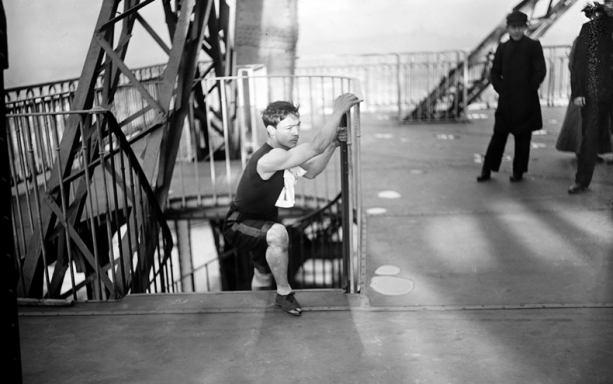
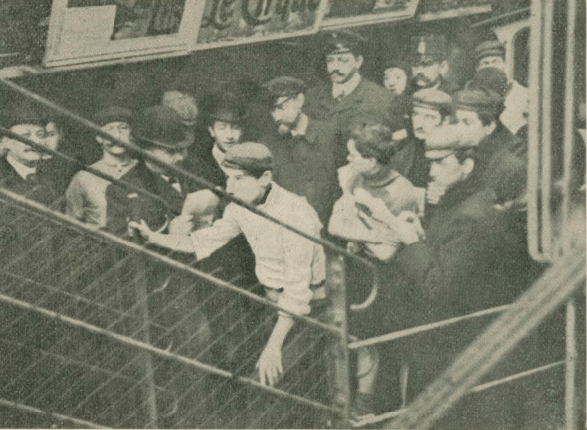
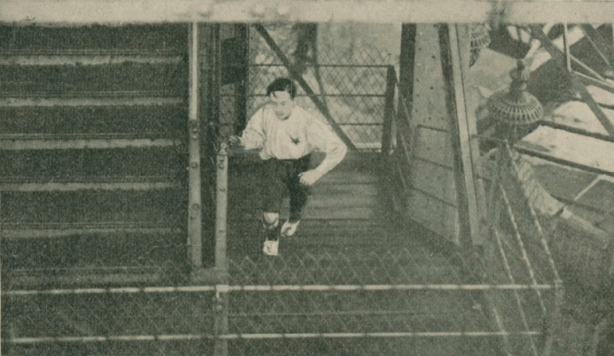
One newspaper report states that ‘competitors at this challenge were not allowed to pull on the railing’. There are some pictures that show competitors holding the railing, but we believe they were promotional shots taken before the event itself. None of the in-race images show runners holding on to the railing, although in one of the pictures below a runner looks dangerously close to reaching out and grabbing it. If, indeed, they didn’t touch the railing at all – and if the post-race report felt it worth mentioning, we may assume they didn’t – then the times they clocked in 1905 become all the more impressive. Ultimately it remains unknown.
The day was split into two sections; in the morning (9am-12pm) ‘veterans and novices’ took on the climb, and in the afternoon (2pm) ‘professional and amateur champions from different athletic groups’.
The start from the foot of the Eiffel Tower. The runners were timed by Salomon, official timer of the A.C.F.
La Vie au Grand Air (a sports journal from the time) explains how the organisers handled the issue of timing:
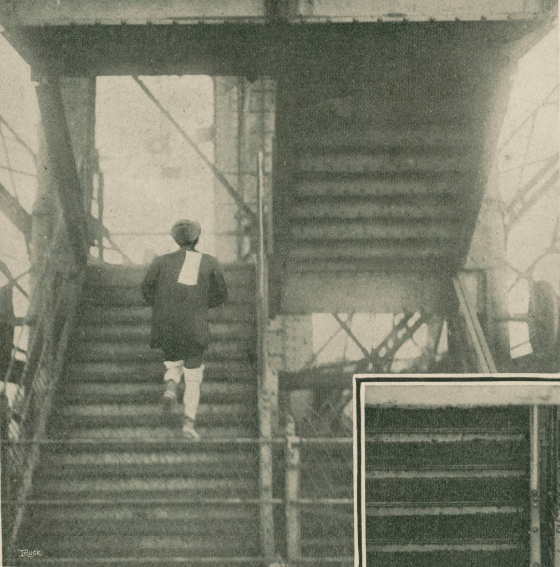
The organisers had a great idea to avoid problems of classing. The runners had attached on their back a small bit of cloth on which was written a letter followed by a number – the minute of the start of their race. The runners went every minute, timed by MM Salomon & Richard. The timer at the second platform only had to calculate the difference between the start time marked on the back of the climber and the time of arrival.
Some racers really struggled on the day. This excerpt from one report will sound familiar to those who have set off a bit too fast at the start of a stair race:
Those who reach their fifth landing can conclude that it is relatively easy and with a bit of courage you could reach the top. Alas! They were disillusioned by the reality at hand – the leaders set aside, you could see the fast runners compared to the exhausted lads before even the first platform, who dragged themselves to the top painfully with sighs and desperate hiccups.
The exertion proved far too much for some runners. Apparently two or three passed out at the top and had to be resuscitated with CPR.
Aside from the stair climbers taking on the challenge as a test of their fitness, there were also ‘some eccentrics’ there on the day who ‘amused the public with unique variations: One man climbed it in 9:59 while carrying a 50kg bag of cement on his back, another climbed it backwards, and a third, a waiter, did the ascent holding a tray with six full glasses.
At the business end of things, the morning waves were highly competitive, with times from the amateurs rivaling those in the elite category later in the day.
The veterans and novices category was won by Luiz in a time of 3:19, he was followed by Pieli in 3.23, with the veteran A. Thiebaud reaching the second platform in 3:29. As seems customary of the time, competitors were largely mentioned by last name only.
‘The arrival at the second floor for one of the runners’
Controversy at the elite race
The main event of the day was widely anticipated. Leading Parisian papers had write ups on the day of the event talking about the upcoming race. One even featured it on the front page.
According to LeJournal, ‘The champions of all sports fully understood the challenge and began training in a different way for this championship’.
Heading into the race, an amateur cyclist named Forestier was the favourite. He had won the Paris-Dieppe cycling race in 1903. Having done some research, he may well be Eugene Forestier, who later became a professional cyclist and came 15th in the 1908 Tour de France, competing for the Peugeot-Wolber team.
Forestier
The fastest time on the day was set by Menu who finished in 3:03. But for some untold reason he was later disqualified.
The earliest report on the race came from the newspaper Le Siecle who listed the top four finishers and their times, but added, ‘We give these results with much reservation as a claim of fraud was placed against the winner.’ Obviously doubts had been raised about Menu soon after the race finished, but no where does it say exactly why he fell under suspicion.
Another report said ‘Menu did a baffling performance: 3mins 3 sec, but was disqualified…the difference in time between the first and the second – 16 seconds – had caused doubts from the start.’
The 16 second gap refers to the difference between Menu and Luiz (winner of the novices category). Presumably, Forestier hadn’t even set off before speculation arose over the speed of Menu’s time. Perhaps he was disqualified for pulling on the railing? It’s hard to think how else he may have ‘cheated’. It will remain a mystery.
With Menu disqualified victory went to the pre-race favourite, Forestier, who finished in a time of 3:12. He was followed by Lepage in 3:16 with Louis Prevost finishing third in 3:17.
‘The start of the first floor’
The morning papers and weekly magazines were full of praise for the performance of the athletes. One even calculated how quickly Forestier would have climbed Mont Blanc by stairs had he maintained the same pace – 2 hours and 15 minutes, apparently.
One paper asked, ‘Is this to say that ‘on the stairs’ cyclists are better than regular runners? This is possible. What is certain is that the ones who came first were especially trained at this sport.’
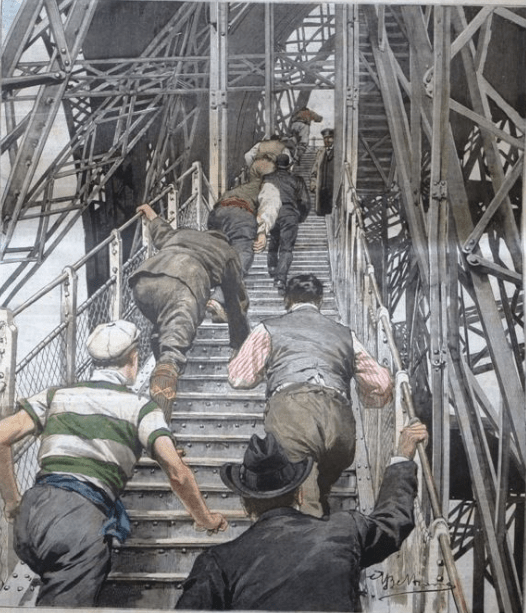
Illustration of the event by Achille Beltrame featured in La Domenica del Corriere, 1905
Le Petit Journal concluded, ‘The event was remarkably organised… It allowed us to see the endurance and agility of all the sportsmen – cyclists, footballers, runners, walkers – that took part in this unique competition.’
Perhaps the best quote from all the coverage:
After all, why would it be stranger to race up the stairs than to run on the road or on a track?
Quatorze juillet (14th July), or Bastille Day as it’s commonly known, is France’s national day. It commemorates the storming of the Bastille at the beginning of the French Revolution of 1789. It has long been a day of celebration and festivity throughout France.
14th July 1903 was a day of sporting revolution. Competitive stair racing began in France.
Read the story of what is probably the earliest documented stair race in history.
Le Championnat de l’Escalier, 1903
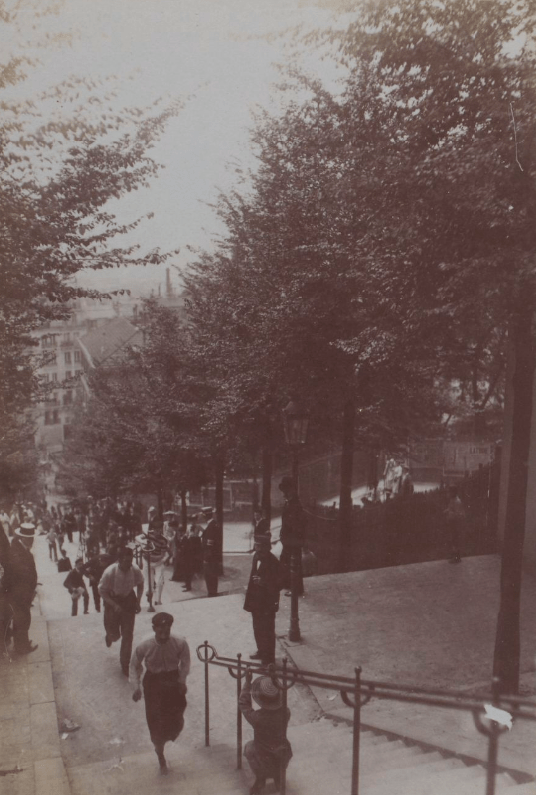
Organised by a publication called Revue Sportive the race took place on the steps of the famous Rue Foyatier (Foyatier Street) in Montmartre, Paris. Rue Foyatier now leads right up to the Sacré-Cœur, but the basilica was still under construction in 1903, so it’s not exactly clear where the racers finished.
The event involved a straight sprint up 256 steps. According to reports, ‘it was a great success, which was deserving of its innovation, in the centre of gay Montmarte on a day of national celebration’.
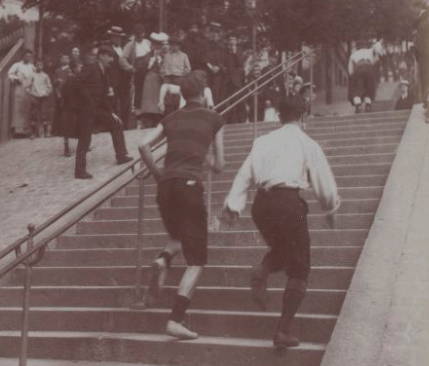
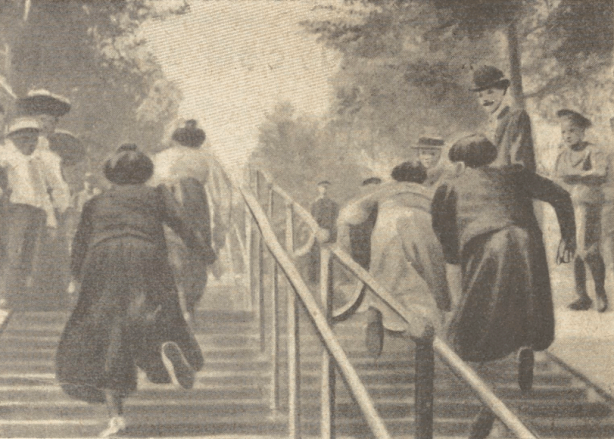
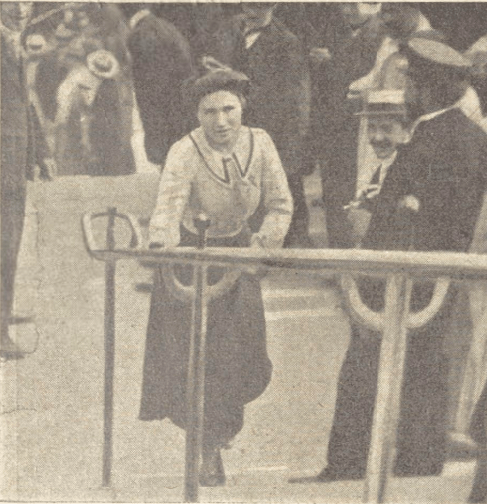
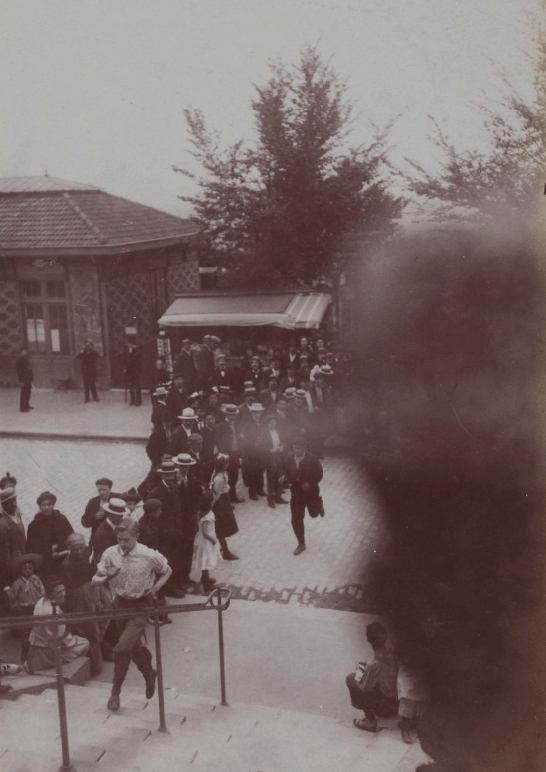
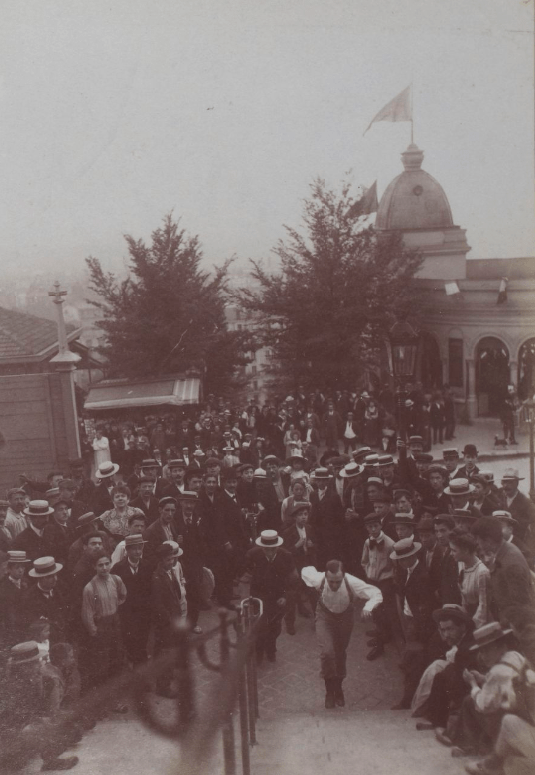
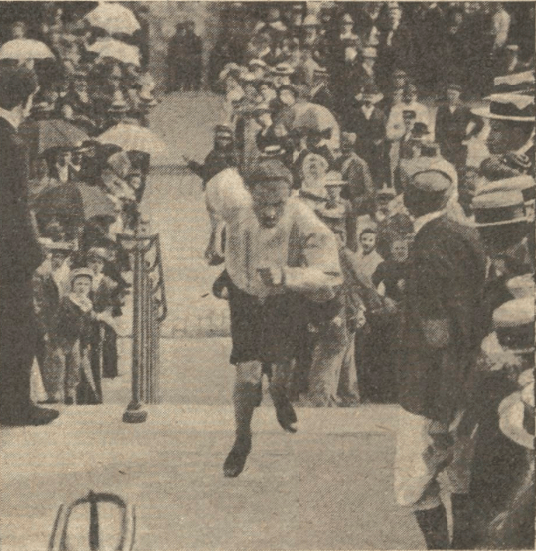
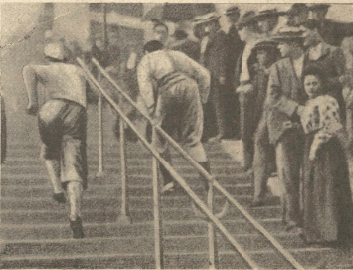
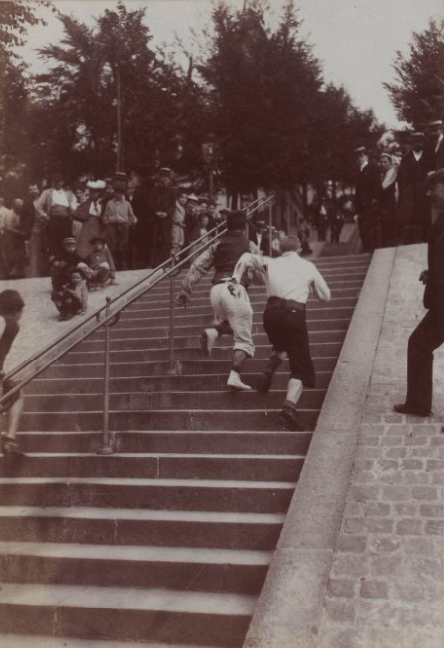
The event was split into four categories: men, ladies, boys and girls. Below are photos/pictures from the event with the original captions translated (in quotation marks where included, otherwise captions are our own).
‘A series in the women’s division’
More than 100 women, men, girls and boys turned up at the start line to take part in the event.
It was ran in a knockout tournament style, with the first to the top of the 256 steps advancing to the next round. It took 28 rounds across all the categories to find the winners.
‘The champion in the women’s race’
‘Some of the competitors at the finish line’
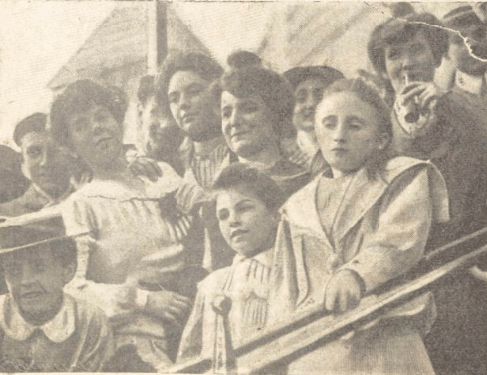
You can see from the photos the event attracted a large crowd of interested spectators. You also get a real sense when reading the coverage (particularly later on with the Eiffel Tower races of 1905 and 1906) that the sport was immediately respected in the highest regard by sports reporters.
‘The finish line in one series’
The winner of the men’s category was a Mr de Baeder (or just, Baeder). He also happened to be the director of Revue Sportive, organiser of the race, and the starter on the day.
The women and girls championship was won by Miss Marguerite Rittrier.
Apparently there was also a category for veterans (seniors) and one of the participants was ‘the famous coach’, Succi. He was ‘much encouraged’ by the crowd who ‘did not expect to see him at an event of this kind’.
One report said, ‘Although having demonstrated the endurance to which he accustomed us, Succi could only take second place. He had probably forgotten to lose weight’.
‘Mr de Baeder, director of the Revue Sportive, wins the championship’
Action from the boy’s race
If you’re ever in Paris, head to Rue Foyatier, to where it all began, and run those steps. This purest of sports began there over 115 years ago.
It’s February 1978, Jimmy Carter is in the White House and Player’s Baby Come Back is about to be knocked off the top of the Billboard 100 by the Bee Gee’s Stayin’ Alive. The Dallas Cowboys are celebrating their second Superbowl win and there’s a huge blizzard heading for New York.
Fred Lebow is six years into his 22-year reign as president of the New York Road Runners. In 1970 he organised the first New York City Marathon for a small group of 55 runners. Now he’s about to see another one of his bold ideas come to fruition – a race up the stairs of the Empire State Building.
Elsewhere in the city, Gary Muhrcke is at home. A former New York City fireman, he was forced to retire on a disability pension almost five years ago, at the age of 33, after injuring his back in a burning building. He’s been taking painkillers for a while, but he’s found that doing a bit of running again actually does a better job of easing the pain than the pills do.
Before his injury Muhrcke was a serious athlete. He won the first NYC Marathon in 1970 in a time of 2hrs 31mins.
Gary Muhrcke wins the first NYC Marathon
In the right circles, he’s a bit of a celebrity. He knows Lebow is putting on a new event; something unique. He’s signed up for it. Hopefully his back will hold out.
Marcy Schwam is going to turn 25 in about a week’s time. Three years ago she walked away from a burgeoning career as a tennis player. She’s a long-distance runner now. A good one. She won the 50km USA Championships at the end of last year. Now she’s training for the Pikes Peak marathon in August, and the 72-mile Lake Tahoe ultra in September. Some incline training in New York’s second tallest building sounds about right. She reckons she probably has a decent chance of finishing near the front, too.
Maybe Fred Lebow had heard about these stair races some students had put on in London in the ’60s. Maybe not.
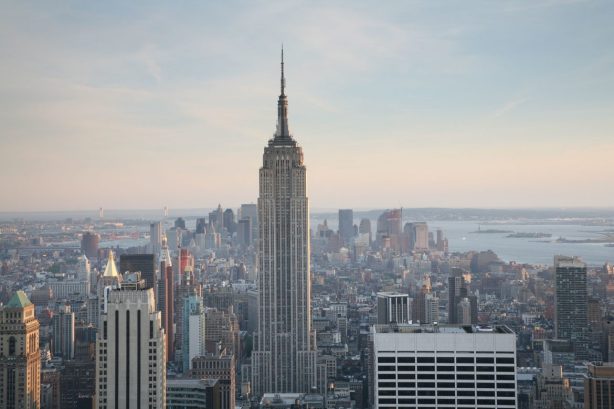
Either way this race up the 1,500+ steps of the Empire State Building was going to be fun. Something different for winter, when the conditions in the city aren’t ideal for road races.
The first Empire State Building Run Up
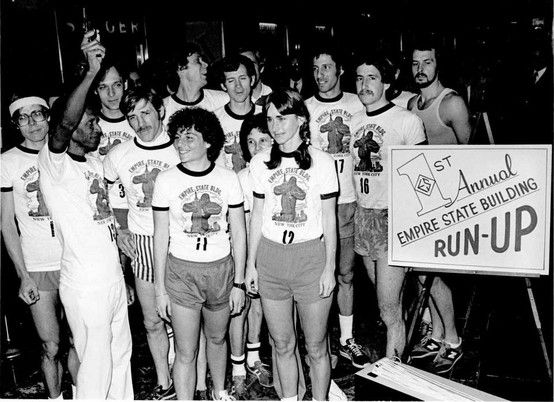
It’s race night. Competitors are waiting in the lobby area for the event to start. They’re wearing t-shirts printed with an image of King Kong hanging off the side of the Empire State Building. It’s the 45th anniversary of the movie.
Muhrcke and Schwam are about to write their names into stair climbing history.
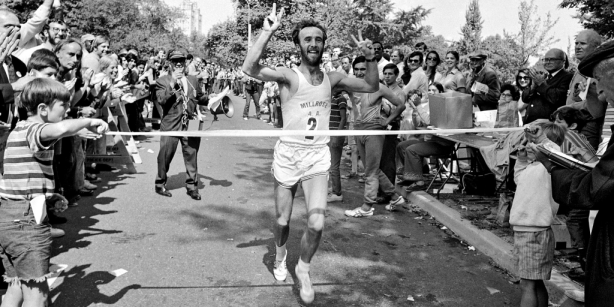
Muhrcke wins the men’s division. Despite a sore back, he reaches the top of the building in 12:33. He gets a lot of heat for taking part in the first ever Empire State Building Run-Up.
Speaking in 1994, Muhrcke recalled: “People asked, ‘What’s a guy who can run up 102 flights of stairs doing with a fire department disability pension?’ Even The Times had an editorial about me. They had to hold a departmental inquiry, but I proved that the ability to run is different from the ability to pull and carry a 200-pound person out of a burning building – and a fireman’s job is to pull and carry. So I still have the pension. And I still have recurring back problems.”
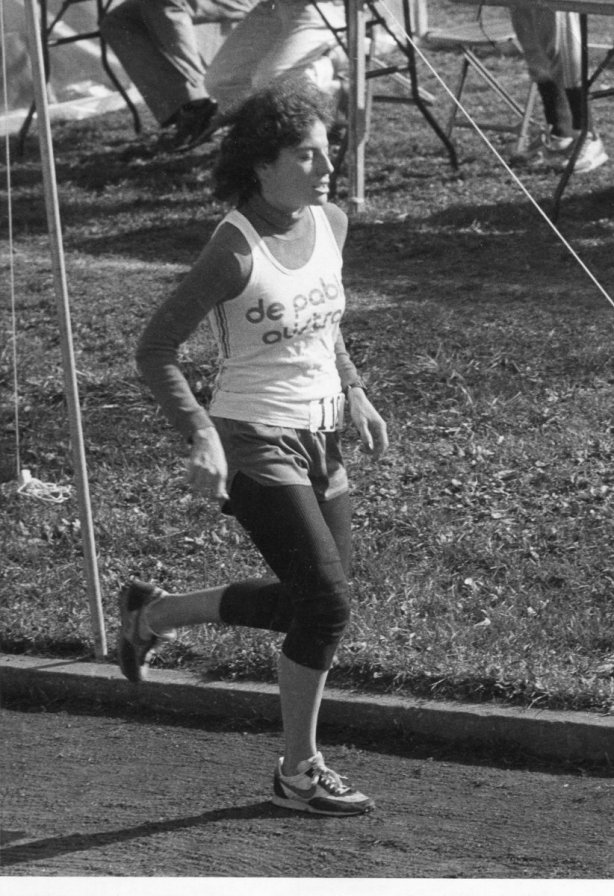
Schwam won the ladies division in a time of 16:04.
She went on to become one of the greatest female ultra runners ever. She became the first woman to complete that Lake Tahoe race she was training for, and she took third in the Pikes Peak marathon. She was just getting started.
Marcy Schwam on her way to setting multiple world records at a 24hr race in 1980
World records for 50 miles, 100 km, and 100 miles all fell to her throughout the 1980s. So did records for most miles run in 24 hours, 48 hours, and 6 days. In 1984 she took second at the gruelling 153-mile Spartathlon race that traces the route taken by Pheidippides between Athens and Sparta, during the Battle of Marathon.
For more on the history of the Empire State Building Run-Up check out our in-depth series covering 30+ years of the event – start with the history of the ESBRU 1978-1980.










 Tower Running UK