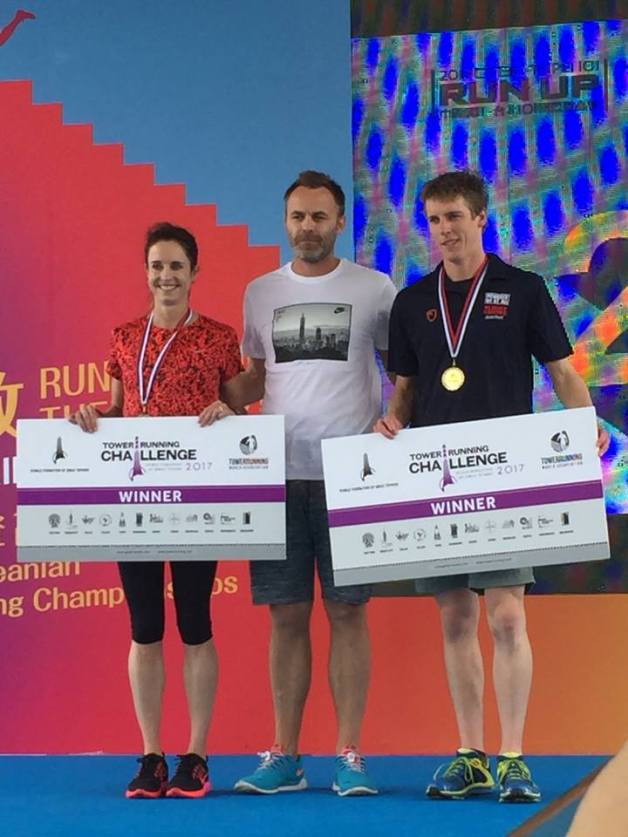
Australia’s Mark Bourne and Suzy Walsham took decisive victories at the Asian-Oceanian Towerrunning Championships this past weekend, held at Taipei 101 in Taiwan.

legacy.skyscrapercenter

Taipei 101 (2,046 steps), venue for the Asian & Oceanian Towerrunning Championships 2017

The Aussie pair returned to Taiwan, having both taken a break from the race – a year off for Walsham and two for Bourne.

Walsham had last one in 2015 and Bourne in 2014, and they returned on Sunday to stamp their dominance on their rivals with clear wins in the eighth tallest building in the world.

In its 13th edition, the race at Taipei 101 is recognised as one of the toughest on the global race calendar.

Walsham reached the top of the building’s 2,046 notoriously steep steps in a time of 13.36 – 20 seconds off her 2015 winning time and personal best- but still well over a minute faster than fellow Australian Alice McNamara who came in second in 14.58.

Similarly, Bourne was well off his best pace at the 508m tall building – 10.52 set in 2013 – but managed to secure victory with a time of 11.24. Behind him was another Australian, Leon Keely – who has previously competed at the highly-demanding Orienteering World Cup, and was taking part in only his second ever stair climb.

Both Bourne and Walsham had taken wins at the Lotte Tower in Seoul, Korea (the fifth tallest building in the world) a fortnight before (you can see footage of Bourne breaking the tape in Seoul here where he beat reigning world champion Piotr Lobodzinski in the much-anticipated exhibition event) so were good bets for their victories in Taipei.

18300857_1883947425264092_777650620072027739_n

Suzy Walsham and Mark Bourne (image courtesy of Towerrunning World Association)

With such dominant displays over the last few weeks, surely both athletes will be looking ahead to the World Championships in China next month with huge confidence? Bourne has shown himself time and again to be one of the only real rivals to Piotr ‘Showtime’ Lobodzinski, especially over the longer distances. Their expected battle for top spot will be one of the highlights of the 2017 season.

Walsham, for the most part, continues to exist in a world of her own at the top of the female rankings, so rarely is she troubled by her competitors. Only Japan’s Yuri Yoshizumi has beaten Walsham in the past six months, and Walsham avenged that defeat at the Lotte Tower Run. She seems undefeatable in 2017, and her rivals at the upcoming World Championship must surely know they are ultimately competing for second place. Andrea Mayr, where are you??

You might also be interested in:

‘The Manchester Myth’ Andi Jones won for the second year in a row at The Torch Stair Run in Doha, Qatar, this past weekend.

3201718234019970749354

The Lancashire man reached the top of the 1,304 step building, which hosted the 2015 world championships, in a time of 7.09. He was in a completely different league to his competitors, which comes as no surprise as Jones has a sub-30min PB for 10k and a 2:15 marathon PB.

In second place was Qatar’s Mohamed al-Obaidly (8.49), with Kenyan Hillary Rotich taking third in 9.05.

Speaking after the event, Jones told Gulf Times, ‘I’m very proud of my achievement and for earning first place once more. My participation in this competition stems from my constant need to challenge myself and surpass my previous results. I prepared really well for this and it paid off in the end. I’m really happy.’

In the women’s open category it was a slightly closer run affair. But Katerina Matousova held on to win in 10.42. She was followed by Lily Saad (11.02) and Ireland’s Gretta Beckett (11.38).

Screen shot 2017-03-19 at 11.42.49 PM

Top three ladies (l-r): Lily Saad, Katerina Motousova, Gretta Beckett

Alston and Scott battle in Miami

Troy ‘The Future’ Alston and ‘The Flying Doctor’ Thomas Scott went head-to-head again on Saturday in another closely run battle, this time at Miami’s One Biscayne Tower.

62603718

One Biscayne Tower, Miami, Florida

The two men, separated in age by 22 years, regularly battle it out at the various Fight For Air Climbs across Florida. Once again it was the younger Jacksonville native, Alston, who took the win.

He reached the top of the 648-step/38-floor building in a time of 3.11 with Scott finishing in 3.25. TJ ‘Candyman’ King rounded out the podium in a time of 4.12.

In the women’s division it was last year’s winner, French woman Anita ‘La Vitesse’ Haudebert, who again took the win, finishing in 5.21, earning her an impressive 8th overall. Andrea Csalari and Gina Allchin were second and third, respectively – with just .1 of a second separating the pair.

Check out the full results.

Like us on Facebook for updates on results and upcoming events.

eiffel tower 1905 picture 4

The effort you need to ascend you can not find in any other sport. It is purely athletic, because it demands from the champion as much strength as speed and as much agility as enduranceLe Journal

The sixth edition of La Verticale de la Tour Eiffel will hopefully take place in 2021. Among the racers set to take part will be the reigning world champions, Piotr Lobodzinski and Suzy Walsham, who’ll be aiming to make it six wins in a row in Paris.

With its narrow field of participants and, of course, its iconic venue, entrance to La Verticale is one of the most sought after in the tower running calendar.

Tracing its origins back as far as 1905, the Eiffel Tower stair climb is probably the world’s oldest tower run, although the first organised stair climb goes back a couple of years before that, when an outdoor stair race was held at Rue Foyatier in Paris 1903. You can read about that event here.

Combining reports from multiple newspapers and magazines from 1905, this is the most detailed account of that first race at the Eiffel Tower.

Le Championnat de L’Escalier 1905

Organised by a magazine called Les Sports, the race took place on Sunday 26th November 1905. It was a cold day with very heavy rains and strong winds. Yet despite the bad weather, large crowds gathered at the foot of the Tower, and on the platforms on the way up, to witness this ‘unique spectacle’.

This comes as no surprise. At the time, the Eiffel Tower was the tallest man-made structure in the world, with the longest staircase. Those in attendance were witnessing history.

Newspaper Le Journal said ‘Les Sports had the unique idea to have athletes from all sports battle it out on a new ground…the stairs.’ The magazine’s aim was to pit champions and elite athletes from various sporting traditions against each other in the ultimate test of fitness. Runners, cyclists and footballers were all among those who took part in the event.

Of the 300 entrants who were due to attend, 283 made it to the start line. Those who took part did so in ‘racing outfits and espadrille shoes’.

The race involved running up 729 steps to the second platform (of three) at the Eiffel Tower. The reason they didn’t run to the top is the organisers felt the stairs on the upper levels were too narrow, and that it could have proved dangerous once the stairwell got crowded.

One newspaper report states that ‘competitors at this challenge were not allowed to pull on the railing’. There are some pictures that show competitors holding the railing, but we believe they were promotional shots taken before the event itself. None of the in-race images show runners holding on to the railing, although in one of the pictures below a runner looks dangerously close to reaching out and grabbing it. If, indeed, they didn’t touch the railing at all – and if the post-race report felt it worth mentioning, we may assume they didn’t – then the times they clocked in 1905 become all the more impressive. Ultimately it remains unknown.

The day was split into two sections; in the morning (9am-12pm) ‘veterans and novices’ took on the climb, and in the afternoon (2pm) ‘professional and amateur champions from different athletic groups’.
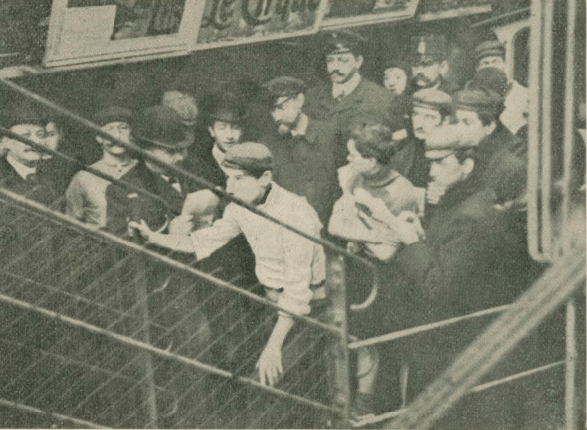
eiffel tower 1905 picture 3

The start from the foot of the Eiffel Tower. The runners were timed by Salomon, official timer of the A.C.F.

La Vie au Grand Air (a sports journal from the time) explains how the organisers handled the issue of timing:

The organisers had a great idea to avoid problems of classing. The runners had attached on their back a small bit of cloth on which was written a letter followed by a number – the minute of the start of their race. The runners went every minute, timed by MM Salomon & Richard. The timer at the second platform only had to calculate the difference between the start time marked on the back of the climber and the time of arrival.

Some racers really struggled on the day. This excerpt from one report will sound familiar to those who have set off a bit too fast at the start of a stair race:

Those who reach their fifth landing can conclude that it is relatively easy and with a bit of courage you could reach the top. Alas! They were disillusioned by the reality at hand – the leaders set aside, you could see the fast runners compared to the exhausted lads before even the first platform, who dragged themselves to the top painfully with sighs and desperate hiccups.

The exertion proved far too much for some runners. Apparently two or three passed out at the top and had to be resuscitated with CPR.

Aside from the stair climbers taking on the challenge as a test of their fitness, there were also ‘some eccentrics’ there on the day who ‘amused the public with unique variations: One man climbed it in 9:59 while carrying a 50kg bag of cement on his back, another climbed it backwards, and a third, a waiter, did the ascent holding a tray with six full glasses.

At the business end of things, the morning waves were highly competitive, with times from the amateurs rivaling those in the elite category later in the day.

The veterans and novices category was won by Luiz in a time of 3:19, he was followed by Pieli in 3.23, with the veteran A. Thiebaud reaching the second platform in 3:29. As seems customary of the time, competitors were largely mentioned by last name only.
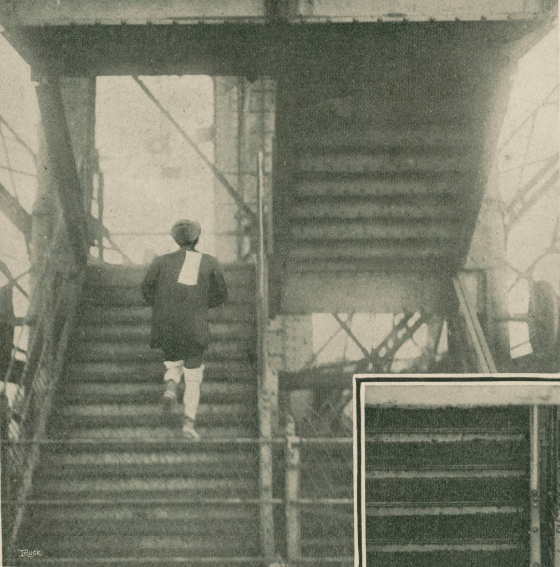
eiffel tower 1905 picture 2

‘The arrival at the second floor for one of the runners’

Controversy at the elite race

The main event of the day was widely anticipated. Leading Parisian papers had write ups on the day of the event talking about the upcoming race. One even featured it on the front page.

According to Le Journal, ‘The champions of all sports fully understood the challenge and began training in a different way for this championship’.

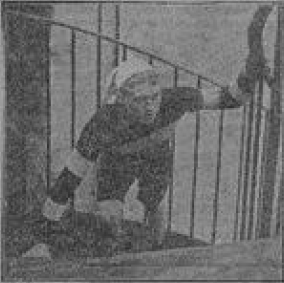
Heading into the race, an amateur cyclist named Forestier was the favourite. He had won the Paris-Dieppe cycling race in 1903. Having done some research, he may well be Eugene Forestier, who later became a professional cyclist and came 15th in the 1908 Tour de France, competing for the Peugeot-Wolber team.
forestier the favourite 1905

Forestier

The fastest time on the day was set by Menu who finished in 3:03. But for some untold reason he was later disqualified.

The earliest report on the race came from the newspaper Le Siecle who listed the top four finishers and their times, but added, ‘We give these results with much reservation as a claim of fraud was placed against the winner.’ Obviously doubts had been raised about Menu soon after the race finished, but no where does it say exactly why he fell under suspicion.

Another report said ‘Menu did a baffling performance: 3mins 3 sec, but was disqualified…the difference in time between the first and the second – 16 seconds – had caused doubts from the start.’

The 16 second gap refers to the difference between Menu and Luiz (winner of the novices category). Presumably, Forestier hadn’t even set off before speculation arose over the speed of Menu’s time. Perhaps he was disqualified for pulling on the railing? It’s hard to think how else he may have ‘cheated’. It will remain a mystery.

With Menu disqualified victory went to the pre-race favourite, Forestier, who finished in a time of 3:12. He was followed by Lepage in 3:16 with Louis Prevost finishing third in 3:17.
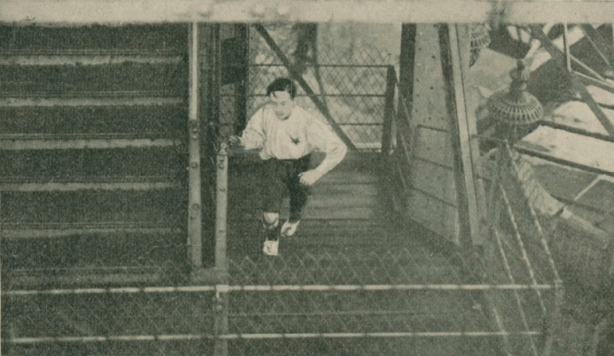
eiffel tower 1905

‘The start of the first floor’

The morning papers and weekly magazines were full of praise for the performance of the athletes. One even calculated how quickly Forestier would have climbed Mont Blanc by stairs had he maintained the same pace – 2 hours and 15 minutes, apparently.

One paper asked, ‘Is this to say that ‘on the stairs’ cyclists are better than regular runners? This is possible. What is certain is that the ones who came first were especially trained at this sport.’
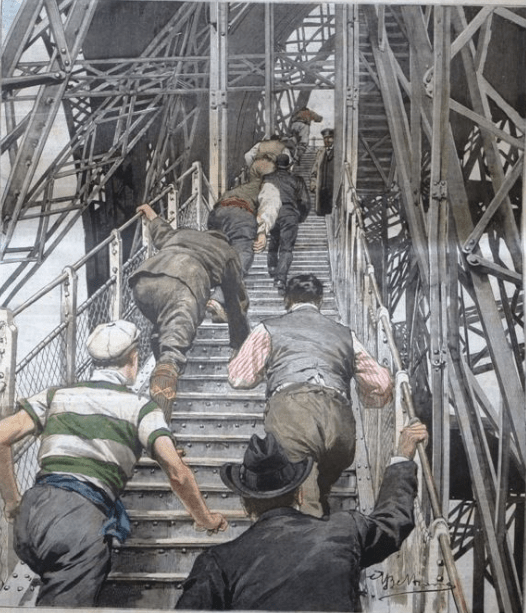
La Verticale 1905

Illustration of the event by Achille Beltrame featured in La Domenica del Corriere, 1905

Le Petit Journal concluded, ‘The event was remarkably organised… It allowed us to see the endurance and agility of all the sportsmen – cyclists, footballers, runners, walkers – that took part in this unique competition.’

 Perhaps the best quote from all the coverage:

After all, why would it be stranger to race up the stairs than to run on the road or on a track?

Why, indeed.

You may also be interested in:

The 2017 UK Tower Running Championship is now well underway, with the first three races already completed. We catch up with all the action from the past couple of weeks.

Beetham Tower Run, Manchester, 2017

The first race was held on 26 February at Beetham Tower, Manchester where a hotly anticipated battle between reigning UK champion Mark ‘The Marauder’ Sims and Slovakia’s Patrik ‘The Nitra Nitro’ Schneidgen – newly resident in the UK- didn’t disappoint.

Schneidgen managed to set a new course record (4.17) at the 798-step venue and also logged his first win over the ever-strong Sims, who finished in 4.29. Full results here.

16939566_10154969182768745_1061597249828066700_n

‘The Nitra Nitro’ Patrik Schneidgen celebrates his victory at Manchester’s Beetham Tower

Conquer the Broadgate Tower, London, 2017

The following weekend, 4th March, the action was in London at Broadgate Tower. Again it was Schneidgen and Sims who went head-to-head for top honours. Sims had defeated the young Slovak track star twice before at the venue in the City of London, but buoyed by his victory in Manchester, Schneidgen entered the race with supreme confidence.

He managed to take another win, in a time of 4.21, with Sims a mere four seconds behind. Full results here.

St George’s Tower Run, Leicester, 2017

Last weekend, 11th March, saw race three of the UK championships in Leicester. The sprint event, at the 351-step St George’s Tower, drew in some well-known European tower runners, including Rolf ‘The Wanderer’ Majcen. With Schneidgen racing in Poland on the same day, it was a perfect chance for Mark Sims to make up some lost ground and win again at a venue he dominated at last year.

Not only did he manage to hold off a strong challenge from Spain’s Christian Lopez, he also broke his own course record (which he set at the venue’s inaugural race last year) by three seconds, finishing in a time of 1.32. Full results here.

Mark Sims stair climber

Two-time UK champion Mark Sims toasts his new course record at St George’s Tower in Leicester

UK Tower Running Championship 2017

In its third year, the UK Tower Running Championship has a simple format and is open to all UK residents. Each race in the series has points on offer, ranging from 40 for the winner down to 10 for tenth place. The full breakdown of points in descending order is: 40, 32, 26, 22, 20, 18, 16, 14, 12, 10.

The person with the mosts points accumulated at the end of the series is crowned UK champion.

Year on year we have added more races to the championship. In 2015 there were four races, in 2016 there were six, and for 2017 we hope to possibly top that. At the time of writing we have had three races, with one more definitely in the calendar for September. We will be adding more races as they are announced and you can track which events are part of the UK championship series by following our regularly updated UK stair race calendar.

You can see the current standings in this year’s championship below.

Screen shot 2017-03-14 at 12.00.19 AM

Like us on Facebook for updates on results and upcoming events.

Main images 1903

Quatorze juillet (14th July), or Bastille Day as it’s commonly known, is France’s national day. It commemorates the storming of the Bastille at the beginning of the French Revolution of 1789. It has long been a day of celebration and festivity throughout France.

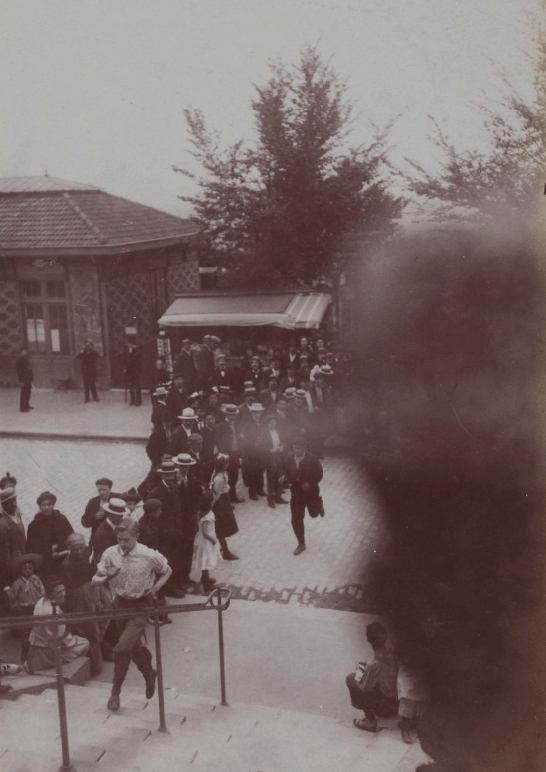
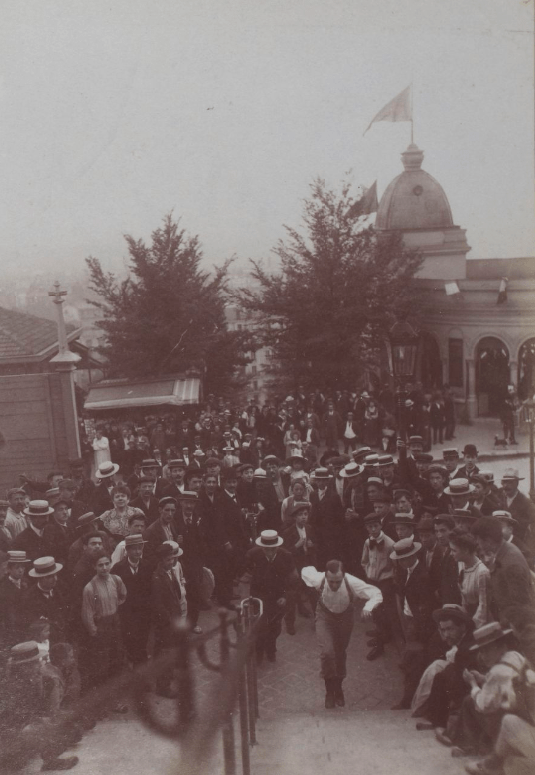
14th July 1903 was a day of sporting revolution. Competitive stair racing began in France.

Read the story of what is probably the earliest documented stair race in history.

Le Championnat de l’Escalier, 1903

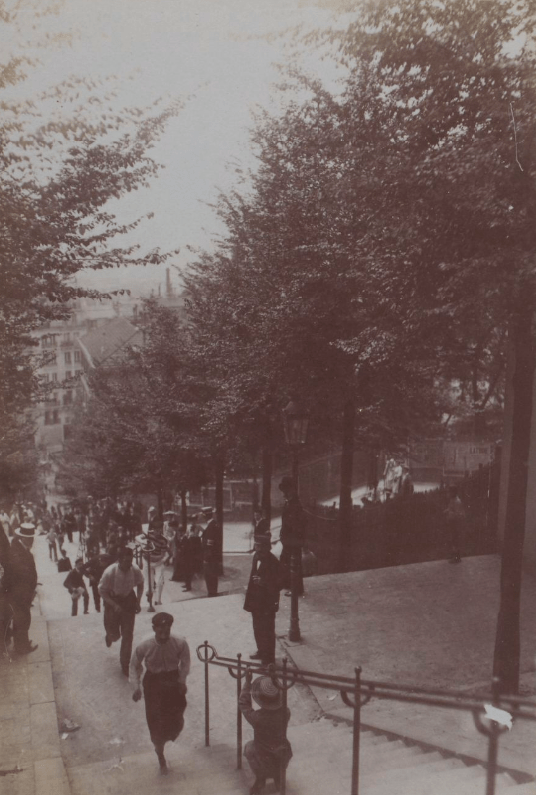
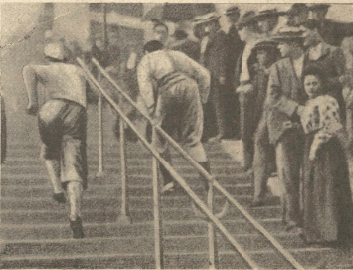
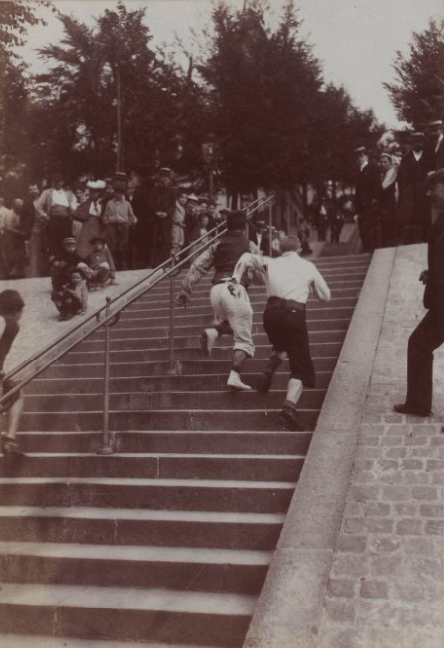
Organised by a publication called Revue Sportive the race took place on the steps of the famous Rue Foyatier (Foyatier Street) in Montmartre, Paris. Rue Foyatier now leads right up to the Sacré-Cœur, but the basilica was still under construction in 1903, so it’s not exactly clear where the racers finished.

The event involved a straight sprint up 256 steps. According to reports, ‘it was a great success, which was deserving of its innovation, in the centre of gay Montmarte on a day of national celebration’.

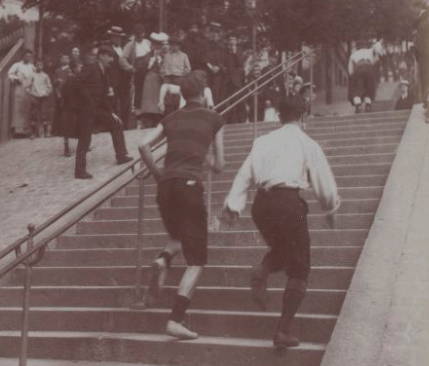
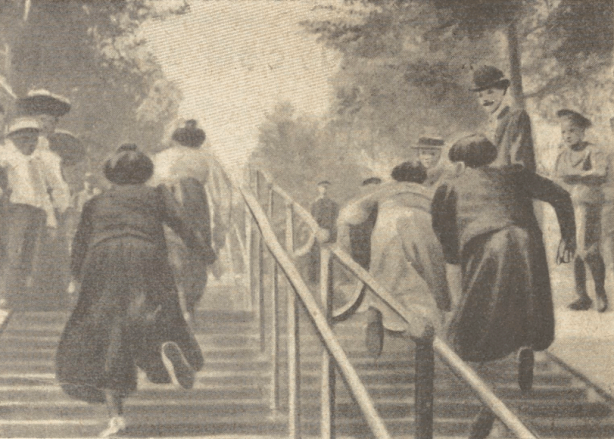
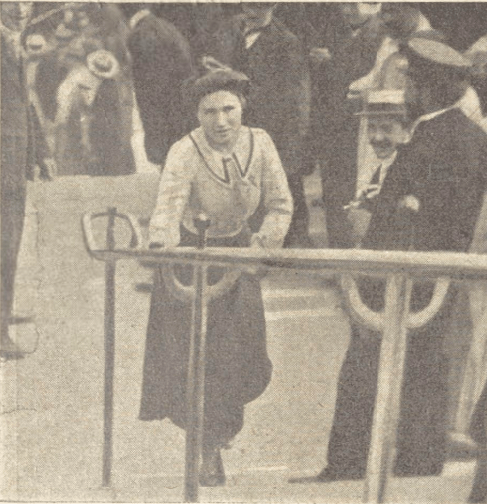
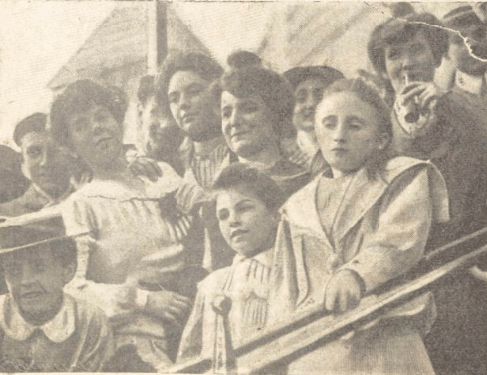
The event was split into four categories: men, ladies, boys and girls. Below are photos/pictures from the event with the original captions translated (in quotation marks where included, otherwise captions are our own).

action from the ladies 1903

‘A series in the women’s division’

More than 100 women, men, girls and boys turned up at the start line to take part in the event.

It was ran in a knockout tournament style, with the first to the top of the 256 steps advancing to the next round. It took 28 rounds across all the categories to find the winners.

winning the ladies championship 1903

‘The champion in the women’s race’

championnat de l'escalier 1903

‘Some of the competitors at the finish line’

1903 stair race Paris 4

You can see from the photos the event attracted a large crowd of interested spectators. You also get a real sense when reading the coverage (particularly later on with the Eiffel Tower races of 1905 and 1906) that the sport was immediately respected in the highest regard by sports reporters.

1903 stair race Paris 6

Montmatre race 1903

‘The finish line in one series’

1903 stair race Paris 3

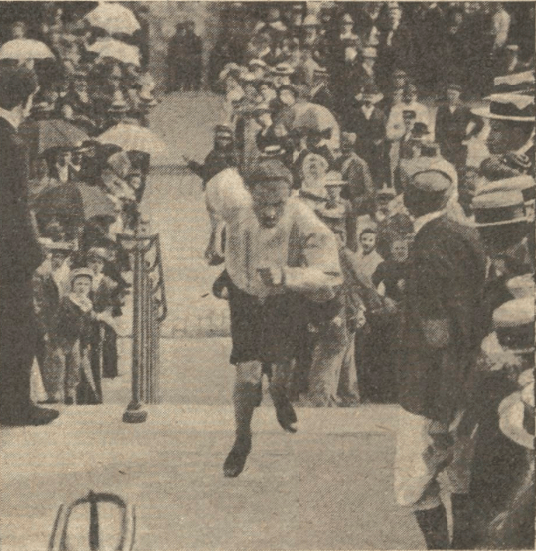
The winner of the men’s category was a Mr de Baeder (or just, Baeder). He also happened to be the director of Revue Sportive, organiser of the race, and the starter on the day.

The women and girls championship was won by Miss Marguerite Rittrier.

Apparently there was also a category for veterans (seniors) and one of the participants was ‘the famous coach’, Succi. He was ‘much encouraged’ by the crowd who ‘did not expect to see him at an event of this kind’.

One report said, ‘Although having demonstrated the endurance to which he accustomed us, Succi could only take second place. He had probably forgotten to lose weight’.

16996079_1012516325558714_689712854379524562_n

‘Mr de Baeder, director of the Revue Sportive, wins the championship’

1903 stair race Paris 1

Action from the boy’s race

1903 stair race Paris 5

If you’re ever in Paris, head to Rue Foyatier, to where it all began, and run those steps. This purest of sports began there over 115 years ago.

You may also be interested in:

Coming out of retirement doesn’t always work out well for sports stars. Some get it just right – think Sugar Ray Leonard (the first time), George Foreman, Michael Jordan (the first time). Others should have left well enough alone – Messrs Armstrong, Ali and Borg et al.

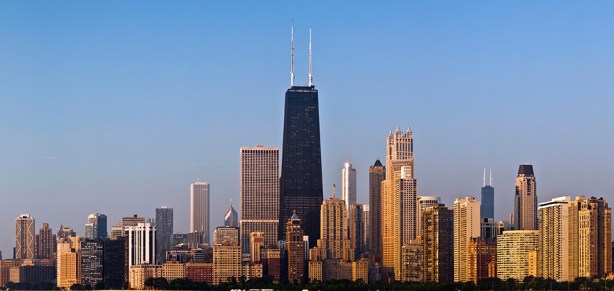
Last Sunday at the John Hancock Center in Chicago, one legend got it almost exactly right.

john-hancock-center-banner

The iconic John Hancock Center is the fourth tallest building in Chicago

If you talk with people who have been involved with stair climbing for years, one name will always eventually come up: Terry Purcell. When he retired from the sport in 2011 he left behind an unrivalled record.

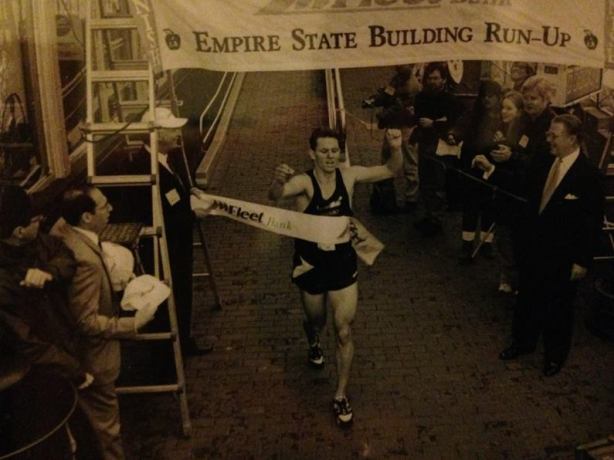
24 years ago, Purcell laid the foundation stone for a now mythic reputation when he took part in his first race at Sydney’s Centrepoint Tower. Baited into it by fellow Australian Geoff Case, who had won the Empire State Building Run-Up from 1991-1993, Purcell excelled from the go. Within two years he had destroyed Case’s record at the Sydney Tower by 24 seconds. In 1998 he won ESBRU himself, and by the time he retired in 2011 he had won more elite races than any other climber before him. His record included five wins from five starts at Chicago’s AON Center (and a long-standing course record that was only broken in February 2017) and nine wins from nine starts at the John Hancock Center.

Purcell didn’t just standout for his incredible speed in the stairwell. He revolutionised the sport with his approach to race technique and specific training.

On technique:

Most guys don’t study technique…which is fantastic for me. They may be fitter and have more time to train, but they waste so much energy. I see people wasting it on the turns by taking too many steps. I see people not using the railing well to save your legs

On his opponents and training:

The way to kick them in the gut is to surge! But who does that? A guy who’s trained to do it for the last six months!”

16831856_10154849324540999_4210814132973125614_n

Terry Purcell winning the 1998 Empire State Building Run-Up

Hustle up the Hancock 2017

It was to the John Hancock Center that Purcell returned on Sunday to chase a record tenth victory. Standing in his way were two of the fastest American stair climbers of the past 15 years – Jesse Berg and Eric Leninger.

Sunday’s event had a beautiful romanticism to it, as old rivalries were reborn and close friendships were cast aside.

When Purcell won his first race at Hancock back in 2002, Berg finished almost two and half minutes behind him in 15th place. For the following two years Berg sat in fifth place, but just 1.30 off top spot. In 2005 he was up to fourth spot and only 48 seconds behind Purcell.

2006,  Berg finished second, going sub-ten minutes for the first time. 2007 he was third while Purcell lowered his course record to 9.30 (beaten by Sproule Love’s 9.23 in 2013). In 2008 Purcell took a break, but he returned the following year to win again, while Berg managed third. And so their rivalry played out until Purcell left the Hancock behind after a final victory in 2011, with Berg once again finishing in third spot – just five seconds behind.

All the while Eric Leninger was approaching unnoticed, slowly improving his times, edging closer to the much-coveted sub-ten minute time. In 2014 he finally managed to go under the ten minute barrier and take his first win. He defended his title in 2015 and 2016, also with sub-ten minute times.

In their time together on the race circuit, Purcell and Leninger developed a close friendship. Here Leninger discusses that bond:

In the last couple years we raced, Terry started becoming somewhat of a coach to me. I’ve always listened (and thought) I knew exactly what he was saying, but the more time goes on, the more I draw from our conversations…past and present. It’s an interesting dynamic between us filled with mutual respect and admiration, but also the fire of pure competition. He’s someone I hold in the highest regard…but also someone who brings out my absolute top level of competition. When he retired, I felt that part of my connection to the sport was lost, as there was no-one else on that starting line that I looked forward to racing as much as him. When I returned to the sport after a year off, Terry became a true mentor….helping me understand that life inside the stairwell is applicable to life outside the stairwell too.

Going for his fourth straight victory on Sunday, Leninger was probably first to know that Purcell was coming out of retirement to once again race up the 94 floors of the John Hancock Center. The ‘fire of pure competition’ was lit again.

But Purcell’s return was not to have the fairy tale ending. There would be no ten from ten.

It was Missoula firefighter, elite triathlete and trail runner, Andrew Drobeck who took the overall victory. He was competing alongside fellow firefighters as part of the ‘Firefighters for New York’ team. Established in 2002, the team competes each year to honour the firefighters who gave their lives on 9/11. His win helped them secure second overall in the team standings.

Drobeck has long been a top-level triathlete, winning in races from sprint to Ironman distance. But he is also no stranger to tower running. He’s won multiple races in full firefighting gear, including five straight wins at the renowned Scott Firefighter Stairclimb in Seattle’s Columbia Tower, where he holds the record of 10.39. But Sunday’s race was his first ‘regular’ race out of gear. There were many curious to see exactly what he could do in the stairs unimpeded by heavy apparatus. He didn’t disappoint.

He took the win in a time of 10.19. It was made all the more impressive by the fact he set off in the 13th wave, weaving his way to the top between reams of slower climbers from earlier heats.

Purcell took second overall, finishing in a time of 10.25. Berg got the closest to the Australian he had ever managed, finishing just one second behind in 10.26. Leninger took fourth in 10.34.

Brilliant to see Terry racing again, and exciting to see an elite athlete from another sport successfully manage the crossover to stair climbing, when many others have fallen short. It will be interesting to see what Drobeck can do in the sport if he makes it a focus.

He will be competing again at the Scott Firefighter Stairclimb on March 12th to raise money for Leukemia and Lymphoma Society. You can donate to that great cause and Drobeck’s attempt at a sixth straight win here.

Check out the full results from Hustle up the Hancock.

Ed. note: My heart leapt when I saw Purcell’s name on the results sheet for Hustle up the Hancock. He was the first stair climber whose results I studied and is a true legend of the sport. It was akin to the feeling I had when Gandalf re-emerged as Gandalf the White in LOTR having battled with the Balrog or when Mick Dundee was revealed to still be alive after the shootout at the end of Crocodile Dundee 2. It’s fantastic to see Terry return, and for me to get to write about an actual race he has taken part in.

Like us on Facebook for updates on results and upcoming events.

The third installment of the UK tower running championship begins in just under two weeks time on Sunday 26th February with The Christie Tower Run at Beetham Tower in Manchester.

beetham-tower-in-manchester

Beetham Tower, Manchester

The first race of the planned six-race series starts at the tenth tallest tower in the UK and is hosted by The Christie Charity. Two-time UK champion, and current course record holder, Mark ‘The Marauder’ Sims will be there on the day to begin the defence of his title, as he seeks to make it three championship wins in a row.

He will be challenged by Slovakia’s Patrik ‘The Nitra Nitro’ Schneidgen aka ‘Mr Guinness’. The two standout stair climbers have had a number of head-to-head battles over the last 16 months, with Sims coming out on top in each race. But sprint specialist Schneidgen will surely welcome a race at the 798 step Beetham Tower. Having run Sims incredibly close at last year’s Broadgate Tower Run Up (877 steps), he will fancy his chances of an upset in Manchester.

Sims, however, is a man for all occasions. It was not by chance the Liverpool-based tower runner found himself in the world’s top-20 at the end of last year. His times and conditioning have been improving year-on-year. He will be determined to secure his status as arguably the greatest stair climber the UK has ever seen by making it three championship titles in a row. With a solid performance at The Climb to Abu Dhabi race last month, Sims is obviously in good shape heading into the domestic season.

The Christie Tower Run will see stair climbing return to the north of England for the first time since 2014. We know there are fast guys in Lancashire, Yorkshire, Merseyside and beyond. Personal trainer Peter Hopson is still record holder at Bridgewater Place in Leeds. Will he be racing in Manchester? Will the event attract some new talent to the UK tower running scene? Can the dominance of Mark Sims be broken by some as yet unknown athlete?

the-christie-tower-run

There is still time to sign up to take part in The Christie Tower Run. The event is open to people of all abilities and there is no qualifying criteria for entry in the UK championship. The top ten finishers will be awarded points and they will carry those into the remaining races of the championship. The athlete with the most points at the end of the year will be crowned 2017 UK tower running champion.

Like us on Facebook for updates on results and upcoming events, plus all you need to know about tower running here in the UK.


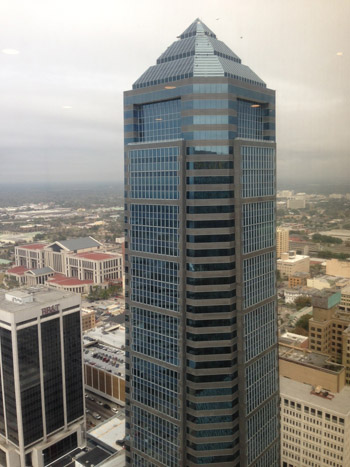
Troy ‘The Future’ Alston aka Stair Climb Elite and Stephanie ‘The Oracle’ Hucko set new course records at the Bank of America Tower in Jacksonville, Florida last weekend.

bank-of-america-tower-jacksonville

The Bank of America Tower, Jacksonville, FL

Locked in a year-on-year rivalry with ‘The Flying Doctor’ Thomas Scott, Alston was aiming to make it six wins in a row as he headed into his hometown event.

The inclusion of John ‘Renegade’ Osborn into the mix this year meant Alston had to dig deep to secure victory again. His time last year at the 832 step Bank of America Tower was an incredibly speedy 4:24.

The Future managed to wipe five full seconds off that, crossing the mat in 4:19.

troy-alston-stair-climb-elite

A victorious Troy Alston celebrates his new course record

Thomas Scott took second in 4:37, with Osborn just behind him in 4:41.

In her first time racing in Jacksonville, Stephanie ‘The Oracle’ Hucko ran the fastest time ever by a woman at the event as she reached the top in 5:21 – only the second ever sub-six minute time in the ladies division.

Coming off a strong fifth place finish at the demanding Empire State Building Run Up just three days before, the Australian’s time was fast enough to earn her an impressive sixth place overall on the day.

Kate ‘The Say Hey Kid’ Mays took second in 6:26, with Suzanne “The Fjord” Bergen completing the podium in 6:30.

Like us on Facebook for updates on results and upcoming events, plus all you need to know about tower running here in the UK.

After years of watching the world’s most iconic stair race unfold without him, Piotr Lobodzinski – the Bull of Bielsk Podlaski – sauntered into Manhattan on Wednesday night and finally won the Empire State Building Run-Up 2017

Follow this link if you’re looking for ESBRU 2018 results.

20170202074402053-640x480

The Polish phenom had waited until the morning before the race before announcing his participation, but it didn’t take long before excitement quickly spread across social media at the prospect of a battle between Showtime and the returning ESBRU champion, Darren Wilson.

Wilson had been absent from the stair climbing circuit for a few months (he qualified for the Ironman 70.3 world championships during his hiatus). But his sudden emergence in Chicago last weekend to smash the long-standing course record at the AON Center sent waves of expectation and speculation through the tower running community.

Could this be the year he matched the exploits of his fellow Australian Paul Crake and came in sub-10 minutes at the Empire State Building Run-Up? It would be a fitting tribute to a race that was celebrating its 40th edition.

With arguably the greatest stair climber of all time also focused on victory, winning would certainly require the perfect race from Wilson.

The signature mass start for the elite racers was as frantic as ever. Italian Fabio Ruga made it into the stairwell first followed by Gustavo Isaac Mendoza. Lobodzinski was next in with Wilson just behind him.

Lobodzinski and Wilson eventually separated from the pack of following elites, staying close together until they entered the 72nd of 86 floors. It was here that the Pole began to gradually pull away.

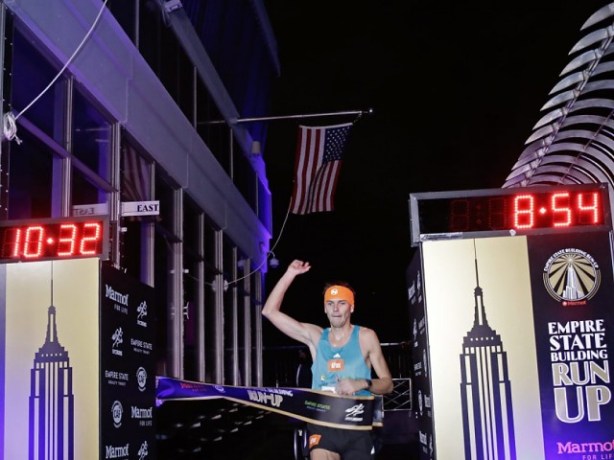
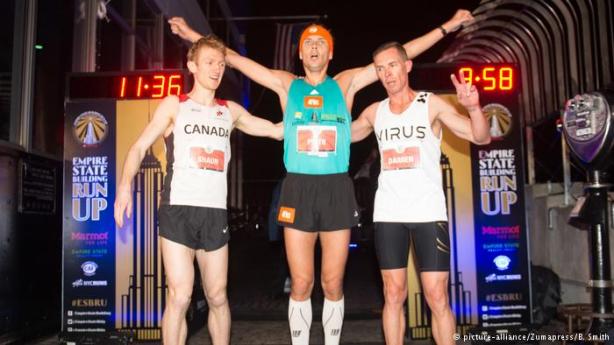
He reached the finish line in a time of 10:31, with Wilson crossing the line just 12 seconds later in 10:43. In-form Canadian stair climber and mountain runner, Shaun Stephens-Whale completed the podium reaching the observation deck in 11:04.

Interestingly, if you take the first names of the top three – Shaun, Piotr, Darren – you can make this anagram – ‘stair run doper, nah’!

37376581_303

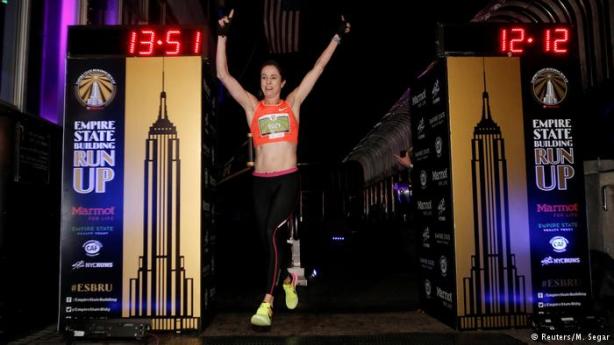
In the ladies division, the incredible Suzy Walsham made it five wins in a row, and secured a record eighth overall victory. She managed it in one of her fastest ever times, too: 12:11.

37376545_303

Four-time previous winner Cindy Harris took second place in a time of 13:15, while Meg Santanna (13:51) secured her first podium finish by holding off a strong challenge from Shari Klarfeld (14:01).

Get the history behind the event and read about the first ever Empire State Building Run Up in 1978.

2048px-nyc_empire_state_building-1170x780

It’s February 1978, Jimmy Carter is in the White House and Player’s Baby Come Back is about to be knocked off the top of the Billboard 100 by the Bee Gee’s Stayin’ Alive. The Dallas Cowboys are celebrating their second Superbowl win and there’s a huge blizzard heading for New York.

Fred Lebow is six years into his 22-year reign as president of the New York Road Runners. In 1970 he organised the first New York City Marathon for a small group of 55 runners. Now he’s about to see another one of his bold ideas come to fruition – a race up the stairs of the Empire State Building.

Elsewhere in the city, Gary Muhrcke is at home. A former New York City fireman, he was forced to retire on a disability pension almost five years ago, at the age of 33, after injuring his back in a burning building. He’s been taking painkillers for a while, but he’s found that doing a bit of running again actually does a better job of easing the pain than the pills do.

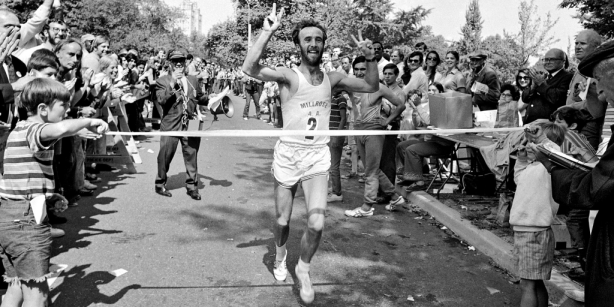
Before his injury Muhrcke was a serious athlete. He won the first NYC Marathon in 1970 in a time of 2hrs 31mins.

csmcy86woaae8eo

Gary Muhrcke wins the first NYC Marathon

In the right circles, he’s a bit of a celebrity. He knows Lebow is putting on a new event; something unique. He’s signed up for it. Hopefully his back will hold out.

Marcy Schwam is going to turn 25 in about a week’s time. Three years ago she walked away from a burgeoning career as a tennis player. She’s a long-distance runner now. A good one. She won the 50km USA Championships at the end of last year. Now she’s training for the Pikes Peak marathon in August, and the 72-mile Lake Tahoe ultra in September. Some incline training in New York’s second tallest building sounds about right. She reckons she probably has a decent chance of finishing near the front, too.

Maybe Fred Lebow had heard about these stair races some students had put on in London in the ’60s. Maybe not.

Either way this race up the 1,500+ steps of the Empire State Building was going to be fun. Something different for winter, when the conditions in the city aren’t ideal for road races.

The first Empire State Building Run Up

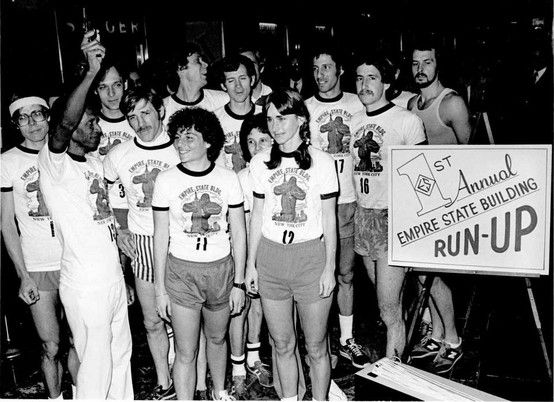
It’s race night. Competitors are waiting in the lobby area for the event to start. They’re wearing t-shirts printed with an image of King Kong hanging off the side of the Empire State Building. It’s the 45th anniversary of the movie.

Muhrcke and Schwam are about to write their names into stair climbing history.

6ef27ac7bb636f92058d08c3838696fd

Muhrcke wins the men’s division. Despite a sore back, he reaches the top of the building in 12:33. He gets a lot of heat for taking part in the first ever Empire State Building Run-Up.

Speaking in 1994, Muhrcke recalled: “People asked, ‘What’s a guy who can run up 102 flights of stairs doing with a fire department disability pension?’ Even The Times had an editorial about me. They had to hold a departmental inquiry, but I proved that the ability to run is different from the ability to pull and carry a 200-pound person out of a burning building – and a fireman’s job is to pull and carry. So I still have the pension. And I still have recurring back problems.”

Schwam won the ladies division in a time of 16:04.

She went on to become one of the greatest female ultra runners ever. She became the first woman to complete that Lake Tahoe race she was training for, and she took third in the Pikes Peak marathon. She was just getting started.

marcy-schwam

Marcy Schwam on her way to setting multiple world records at a 24hr race in 1980

World records for 50 miles, 100 km, and 100 miles all fell to her throughout the 1980s. So did records for most miles run in 24 hours, 48 hours, and 6 days. In 1984 she took second at the gruelling 153-mile Spartathlon race that traces the route taken by Pheidippides between Athens and Sparta, during the Battle of Marathon.

For more on the history of the Empire State Building Run-Up check out our in-depth series covering 30+ years of the event – start with the history of the ESBRU 1978-1980.

Darren ‘Optimus Climb’ Wilson emerged from his hiatus last weekend to set a new course record at the AON Center in Chicago.

The Australian star is in incredible form ahead of the 40th edition of the Empire State Building Run Up (1 February), where he hopes to repeat his 2016 victory.

12316399_748227501987599_6504169789719337693_n

Optimus Climb: Darren Wilson – record holder at the AON Center, Chicago

The AON Center stair climb is a very competitive event in the USA race calendar, regularly drawing in the country’s best tower runners. The list of former winners is a who’s who of some of the sport’s greatest ever stair climbers: Sproule Love, Jesse Berg, Eric Leninger, Justin Stewart.

At the top of the AON Center pile is Australian Terry Purcell. A former ESBRU winner (1998), and victorious in multiple climbs throughout his long stair climbing career, Purcell’s record time of 9:26 was set in 2009 – the last of his five victories (from five starts) at the 80-floor building.

Wilson smashed the record by 25 seconds, setting a new time of 9:01 – a record we can almost guarantee will remain untouched for years.

Big D Climb in Dallas, Texas

9-bank-of-america-plaza-dallas-texas-usa1

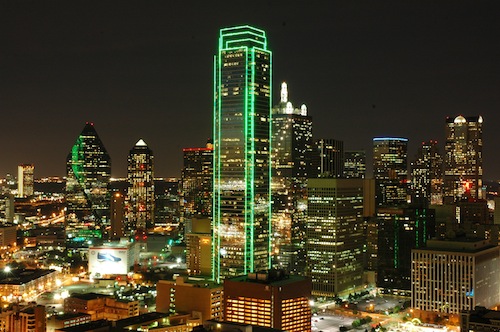
The Bank of America Plaza in Dallas

Down in Dallas it was the 9th edition of the Big D Climb at the Bank of America Plaza (1,540 steps). Stair climbers descended from around the USA to vie for supremacy, and it was ‘The Molten Puma’ Thomas Scott from Florida who took the win in 9:11.  Mark ‘Lord of the Incline’ Ewell from Colorado Springs wasn’t far behind in 9:23.

With the Cowboys having crashed out of the NFL playoffs a few weeks back, the locals were looking for some sporting Texan star to brighten their mood, and Scott ‘The Chalice of Thunder’ Stanley was good for the job. He made sure a Texan was standing on the podium, taking third in 10:05. Big shout out to one of our stair climbing heroes, Hal ‘The Statesman’ Carlson, who at 64 (!!!) took a massively impressive fourth place finish. Amazing longevity!

In the women’s division it was local athlete Anita ‘A for Aggression’ Averill who took the win (12:18). She was followed by another Texan, Jackie ‘The Stair Corroder’ Rust (12:44), with Madeleine ‘The Oakland Bad Ass’ Fontillas Ronk taking third (13:40). Our current stair crush, Sue ‘The Eraser’ Glaser, took fourth place (14:01).

Like us on Facebook for updates on results and upcoming events, plus all you need to know about tower running here in the UK.

The tower running season took off fully last weekend, with races in Italy, USA and Dubai. With the world number one and number four both in action, we take a look at some of the key results.

Vertical Run Almas Tower

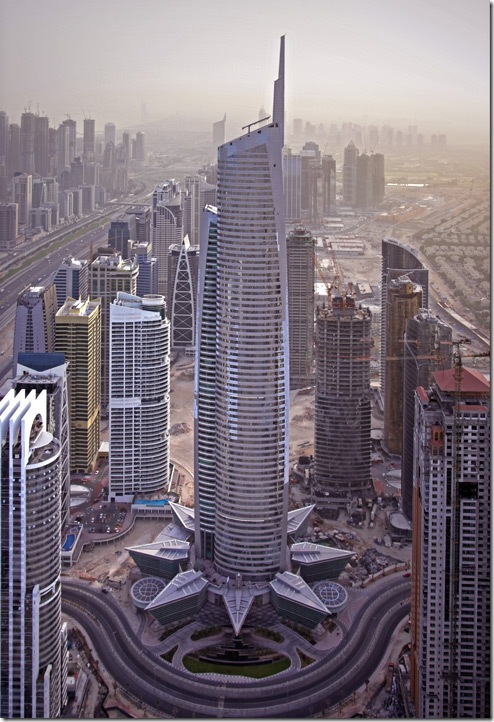
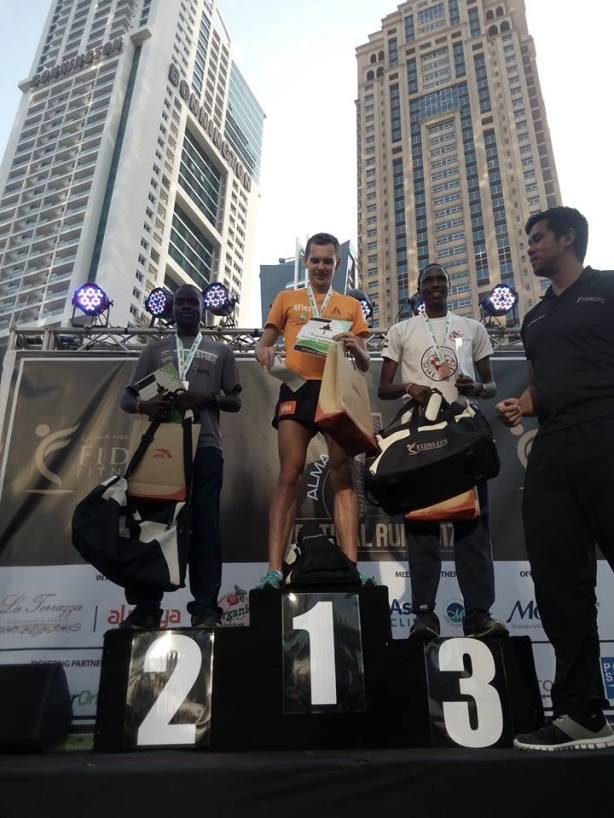
World tower running champion, Piotr ‘Showtime’ Lobodzinski is currently in the UAE ahead of Friday’s exhibition race in Abu Dhabi, which he has been helping to promote. He was in nearby Dubai on Saturday to take part in the 1,600 step Vertical Run Almas Tower.

almastowerdubaiuae_thumb

The 64-floor Almas Tower in Dubai

Despite a highly competitive field of athletes, that included Rolf Majcen and Iman Koushki, Lobodzinski showed once again that he is in a different league.

Victory for the Bull of Bielsk Podlaski was never in doubt as he sauntered to a winning time of 8:07. Behind him in second place was Ugandan Ismail Ssenyange, who has a 62min half marathon, 2.18 marathon and 30min 10km performances on his record. Ssenyange managed an impressive 8:43, but was some way off the Polish superstar.

Third place was taken by Kenya’s Henry Kipsang, another highly accomplished road runner. A 2.13 marathoner, he was just behind in 8:45. The UK’s very own Paul ‘The Puppet Master’ Faulkner put in a brilliant performance to take fourth place in a time of 8:58.

The extent of Lobodzinski’s win against this level of high-caliber road runners shows what a brilliant athlete he is, and also highlights how the physical requirements needed for fast times on the flat don’t always translate to fast times on the stairs.

16195000_594943680701786_8490660936857100220_n

The top three at Vertical Run Almas Tower in Dubai

In the women’s division it was another Pole who came out on top. Anna Celinska has previously medalled at a long-distance mountain running world championship and was third in the Polish marathon championship in 2014. She managed to finish 13th overall in Dubai, in a time of 10:31.

That was 20 seconds ahead of Russia’s Natalia Sedykh (10:52), who is a highly experienced ultra runner and was a stage winner at the 2016 Marathon Des Sables.

Third place in the ladies division went to another excellent road runner, Amina Mhih (11:56) from Morocco.

Latina Vertical Sprint

Over in Latina, Italy there was a Towerrunning World Association 60 point race. An initial qualifying round whittled the field down to the top ten men and top five women, and among them were some big tower running names.

torre-pontina-2

Torre Pontina: venue for the Latina Vertical Sprint (702 steps)

‘The Zilina Avalanche’ Tomas Celko took the spoils in a time of 3:14, setting a new course record in the process. Italy’s Fabio “Stair Charmer” Ruga was just behind in 3:20.

Lenka “Czech Yourself Before You Wreck Yourself” Svabikova aka “Shredder” aka “Operation Abs” took a straightforward win in the women’s division.

There were a number of results out of the USA as their stair climbing season got under way. With multiple climb options at all three different events, we found it a bit of a challenge to do write ups for each race. But we hope to have a post on those races before the week is out, so be sure to check back.

We will note, though, that we were highly pleased to see Justin Stewart back on the stairs taking a win in Indianapolis. One of the finest stair climbers in the USA, we firmly believe that given the chance he could be the man to challenge the European stronghold on the TWA rankings. If only it were that simple.

Like us on Facebook for updates on results and upcoming events, plus all you need to know about tower running here in the UK.

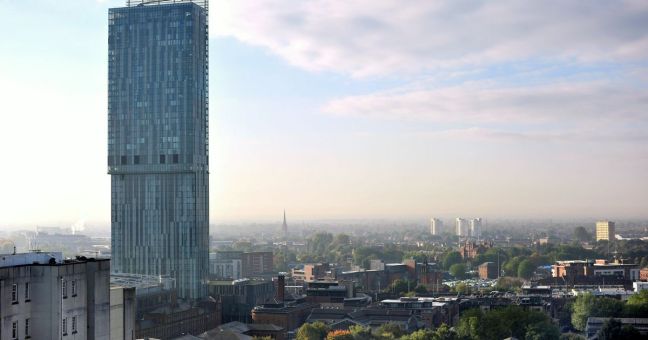
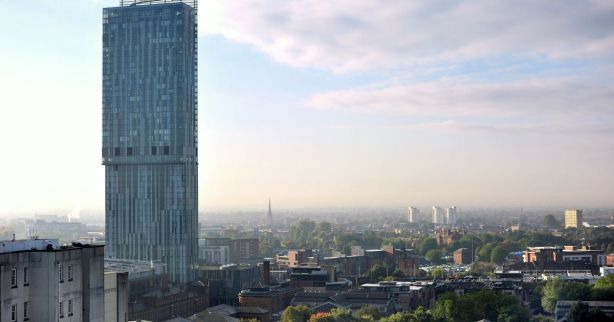
Stair climbing returns to Manchester on Sunday 26th February 2017 with The Christie Tower Run at the city’s 46-floor Beetham Tower. Standing at 169m, and with 798 steps, Beetham Tower is the tallest UK building outside of London.

js74301187

Beetham Tower has 798 steps and is the 11th tallest tower in the UK

It’s been three long years since the north of England held a stair climb (the 2014 Great Yorkshire Stair Climb at Bridgewater Place in Leeds), so this event will be welcome news for tower runners in that part of the country. Getting down to London for races has been demanding for northern-based athletes.

The lack of stair climbs up there has been frustrating. Especially given that reigning UK tower running champion, Mark Sims, is based in Liverpool and the highest ranked UK stair climber in the world, Rich Sirrs, is from Hull.

There has been ongoing demand and interest among athletes so this Manchester stair climb is a perfect opportunity for people to turn out and test themselves in a building that’s taller than some popular race venues in London.

UK Tower Running Championship

The event will also be the first race in the 2017 UK Tower Running Championship. Now in its third year, the championship has been dominated the last two years by Mark Sims. Perhaps this new Manchester stair climbing challenge will unearth some fresh talent that might be able to challenge the most decorated UK stair climber of all time.

The second event of the championship will take place just two weeks later down in Leicester, when the LOROS St George’s Tower Run enjoys its second edition. A popular and highly competitive event in 2016, the LOROS team have already doubled the number of participants for this year.

They are hoping well over 100 racers will take on the 351 step sprint race on 11 March. This event, in a relatively small building, is an excellent entry level race for people curious about the sport. We highly encourage people to sign up and invite their friends to join them in this stair climbing challenge in Leicester city centre.

9733936-large

St George’s Tower in Leicester is venue for the second race of the 2017 UK Tower Running Championship on 11th March 2017

More events will be added to the UK championship later in the year as new races are announced. We hope this will include more stair climbs outside of London, so the competition can stretch far beyond the borders of the capital.

Like us on Facebook for updates on upcoming events and all you need to know about tower running here in the UK.

Gabbert and Jacobs win in Berlin

Posted: January 15, 2017 in News

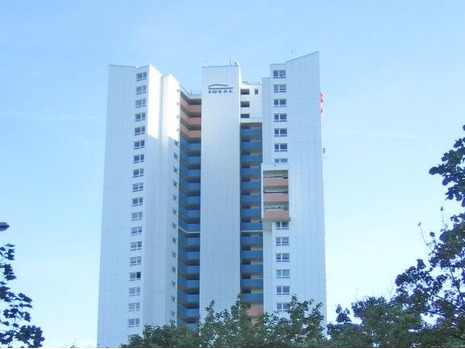
The German stair climbing season got underway in cold wintery conditions last weekend with a race at the 29 floor Ideal-Hochhaus in Berlin.

4-879

The 29 floor Ideal-Hochhaus in Berlin

It was the 17th edition of the popular Towerrunning Germany event, and despite the absence of some of the leading European runners it proved to be highly competitive.

Tower Run Berlin

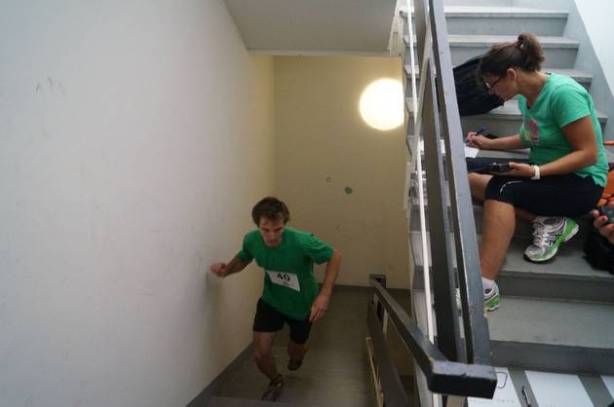
The race started with a 400m run to the entrance of the Ideal tower block, located in the south of the German capital. Snow the previous day made the run quite treacherous, with many runners sliding around in the slush covered car park leading to the stairs. Once inside the gritty, exposed stairwell, athletes had to climb 465 steps before reaching the top. The narrow stairs make overtaking difficult so there was quite a push in the run for prime position entering the stairwell.

39ce0520-jpg

World number two, Christian Riedl, at a previous edition of the Berlin Tower Run

It was tower running regular Johannes Gabbert who took the win. Entering the stairs first ahead of Gerrit Kröger, he maintained the front position right to the top, eventually finishing in a time of 3:32.38. Gabbert had taken a strong victory in Frankfurt last summer, just seconds outside the course record, so it was perhaps no surprise to see him at the top of the podium.

csm_1022939377_fac6cde586

Gabbert on his way to victory in Frankfurt in 2016 (credit – MOZ/Martin Stralau)

Just two seconds behind him in a time of 3:34.49 was Gerrit Kröger. The Kiel native was sixth in the German Towerrunning Cup in 2016 and has a string of excellent performances behind him over the last couple of years, including a second place finish at last years’ Berlin Tower Run.

Completing the podium was Poland’s Karol Galicz, who finished in 3:36.76. Only the top three made it in under the 3.40 mark, separating themselves from the rest of the field by ten clear seconds.

Sylvia Jacobs Shows Young Guns How It’s Done

In the women’s division, reigning German Towerrunning champion Sylvia Jacobs proved once again that age is no barrier to success in this sport. The 54 year old held off a close challenge from much younger rivals to take victory in a time of 4:38.25.

Just behind her was Corinna Beck who, like her team mate Kröger, had also finished second last year. She reached the top in 4:43.38, with Anna Lena Böckel just behind in 4:45.59.

Like us on Facebook for updates on upcoming events and all you need to know about tower running here in the UK.

Sims retains UK Championship title

Posted: November 28, 2016 in News

Mark ‘The Marauder’ Sims retained his UK championship title last Sunday with a win at the Broadgate Tower Run Up.

15192630_1801262700145378_4981994698969347114_n-1

Mark Sims – 2016 UK Tower Running Champion

The Liverpool-based elite dominated the five-race UK championship, which began in February, taking four wins and a third place finish.

His four victories came in Leicester (St George’s Tower), Portsmouth (Spinnaker Tower), London (20 Fenchurch St and Broadgate Tower). His third place finish came back in May at Broadgate Tower.

Outside of the designated championship races, Sims put in impressive performances elsewhere throughout the season. He took wins at the inaugural Grate 48 at London’s Leadenhall Building and proved himself among the world’s best at the European Championship in the summer.

Perhaps most notably he was the highest placed UK finisher at Vertical Rush back in March. There he beat the current world number eight, Emanuele Manzi, to fourth spot, finishing just 17 seconds behind world number one Piotr ‘Showtime’ Lobodzinski in the process.

This season of standout performances has now brought Sims to 20th in the world, his highest position to date (though it should be noted that his abilities warrant a higher position, and it is only the weighting of global towerrunning events that limits Sims from pushing further into the world rankings).

A huge congratulations to Mark on retaining his title and showing the world that the UK has some of the best tower running talent around.

Like us on Facebook for updates on upcoming events and all you need to know about tower running here in the UK.