2011 Bartosz Swiatkowski (POL) 3:43.92 Isabela Zatorska (POL) 4:46.65 2012 Fabio Ruga (ITA) 3:39.53 Anna Ficner (POL) 5:08.59 2013 Bartosz Swiatkowski (POL) 3:42.82 Isabela Zatorska (POL) 4:46.74 2014 Piotr Lobodzinski (POL) 3:36.29 Dominka Wisniewska-Ulfik (POL) 4:53.20 2015 Piotr Lobodzinski (POL) 3:33.88 Dominka Wisniewska-Ulfik (POL) 4:49.57 2016 Christian Riedl (GER) 3:34.41 Anna Ficner (POL) 4:40.84 2017 Piotr Lobodzinski (POL) 3:34.09 Anna Ficner (POL) 4:40.70 2018 Piotr Lobodzinski (POL) 3:34.97 Zuzana Krchova (CZE) 4:42.36 2019 Piotr Lobodzinski (POL) 3:34.09 Iwona Wicha (POL) 4:39.74 2022 Fabio Ruga (ITA) 3:41.8/3:50.7 Anna Ficner (POL) 4:28.3/5:16.98
The race at Rondo 1 race often involves a qualifying run to determine positions for a final. Times from 2011 to 2019 are winning times from the final, but the fastest time in each year has often been set in qualifying. The men’s course record of 3:27.60 was achieved by Piotr Lobodzinski in the qualifying round of 2014. The 2022 race format involved two runs up the tower, with both times combined for a total.
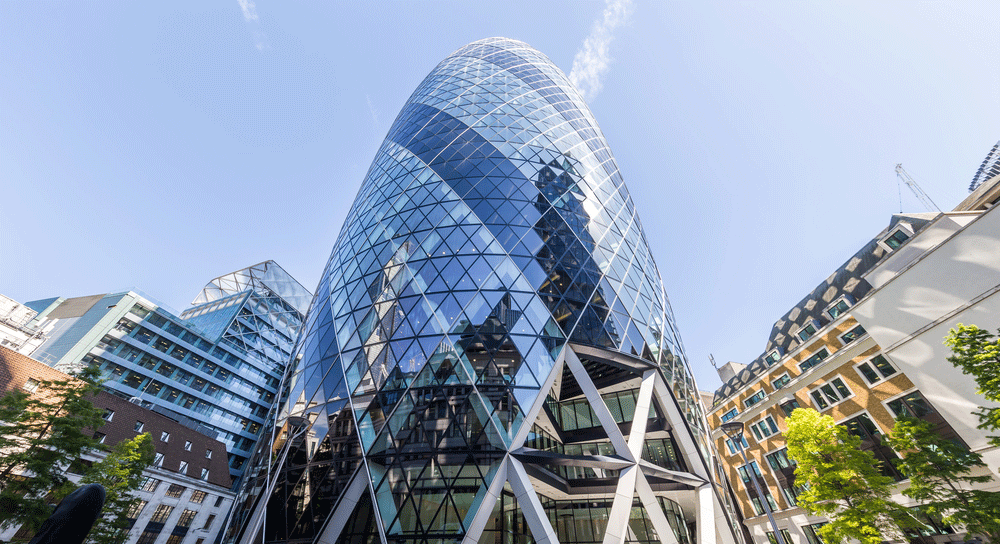
For over a decade the NSPCC Gherkin Challenge has been one of the most popular stair races in the UK. We take a look back at the first edition of the event in 2010.
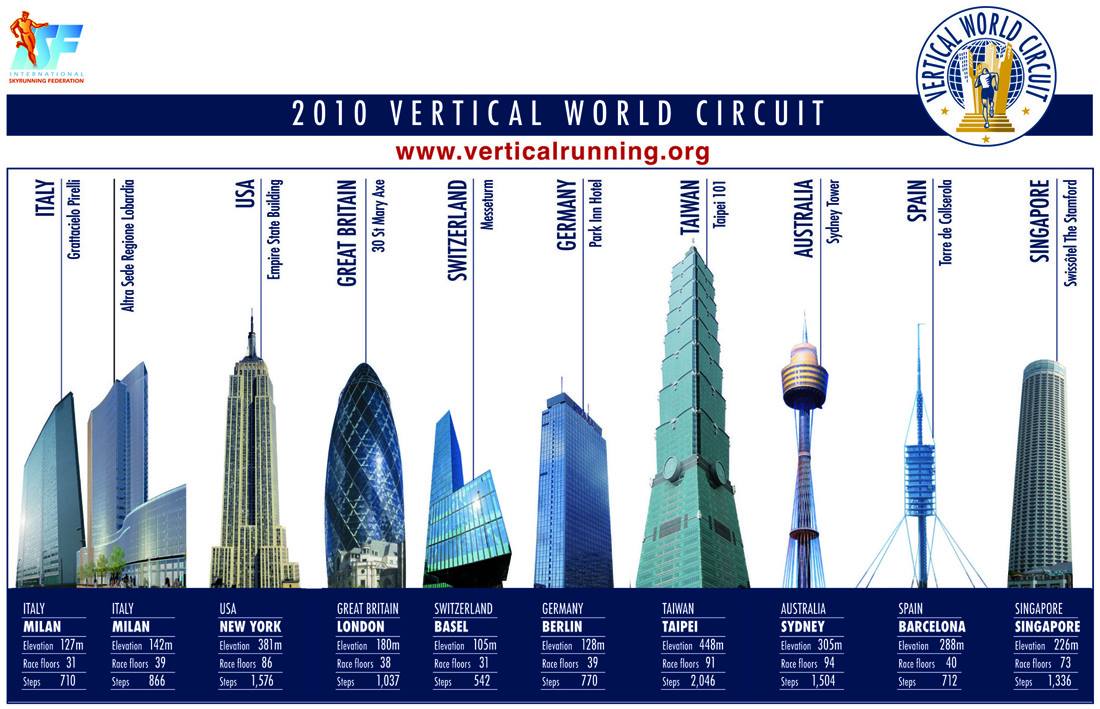
Back then, the event (then known as NSPCC Step Change) was part of the newly established Vertical World Circuit (VWC) and attracted a spread of top international athletes.
In the women’s division, New Zealand mountain runner Anna Frost was there alongside Italy’s Daniela Vassalli and Cristina Bonacina.
The trio had been among a stellar field of tower runners that had battled it out in a double run in Milan two weeks before, in the first event of the VWC 2010.
Vassalli (winner of the inaugural Vertical World Circuit in 2009) had won that event in Milan, with Frost taking second.
In this new event in London, two runners were being set off at the same time every 30 seconds. Vassalli and Frost were paired together, so it was set to be a genuine side-by-side battle up the unique-looking tower’s 1,037 steps for top points
In the men’s event, Italians Marco De Gasperi and Fabio Ruga were the pre-race favourites and they too were paired together.
Ruga had already picked up points on the VWC, having finished second behind Thomas Dold in Milan a fortnight before. De Gasperi had yet to race in the series. It was guaranteed to be a close battle.
Other well-known tower runners in attendance included Spain’s Ignacio Cardona and Dario Fracassi from Italy.
Watch the video below (click here if embed not showing) to see Daniela Vassalli warming up (0:18), an interview with Anna Frost (0:30), De Gasperi and Ruga setting off (1:38), Vassalli and Frost starting (1:51), Fabio Ruga finishing (2:50), Vassalli finishing (2:58), Cristina Bonacina finishing (3:21) and Ignacio Cardona on the floor at the finish (4:06).
Fabio Ruga won that day, setting the fantastic course record of 4:07 that still stands. De Gasperi finished just four seconds behind his compatriot in 4:11. Ignacio Cardona was third in 4:18.
In the women’s race it was Daniela Vassalli who took top spot with a 5:42 finish. Anna Frost (who would go on to win Vertical Rush in London just over two weeks later) was just six seconds back in 5:48, while Rachael Orr (GBR) finished third in 6:13.
Getting on the stepmill at the gym might well be the best part of your workout. But can you imagine being stuck on it for up to 10 hours a day, every day?
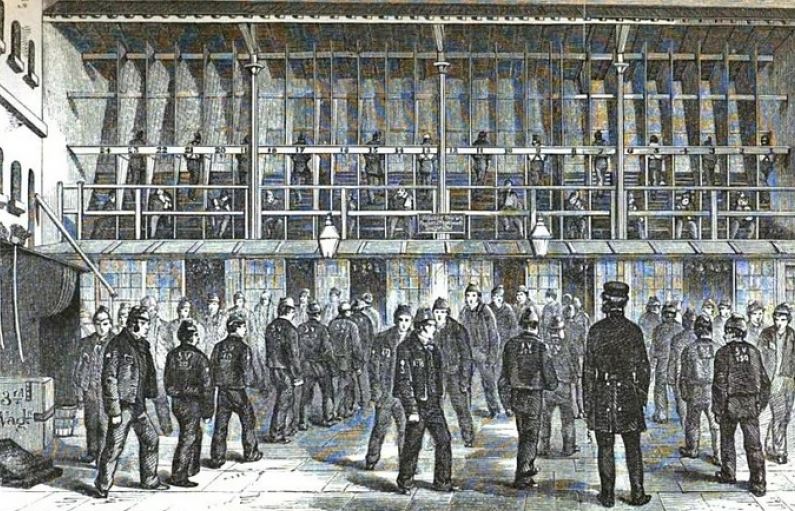
That was the daunting task that faced inmates at many British prisons in the 1800s.
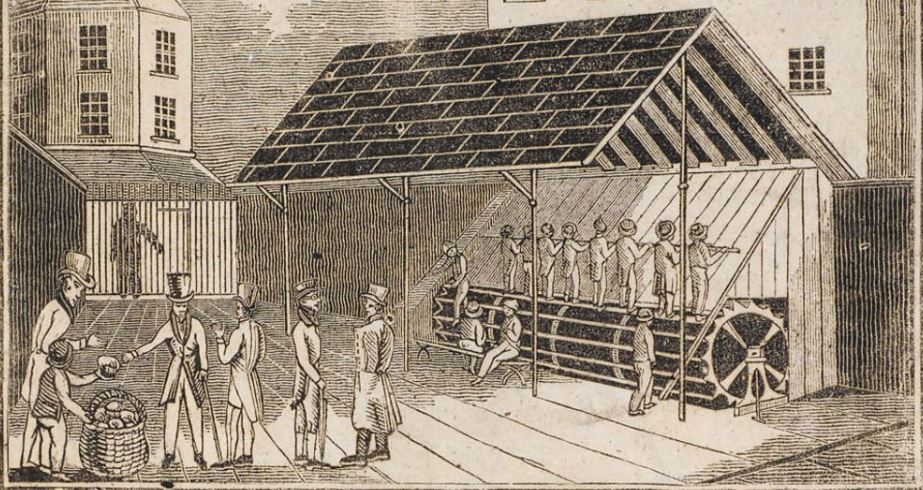
William Cubitt, a British engineer, designed the stepmill as a means of preventing idleness among prisoners, with the resistance to the turning wheel provided by straps and weights. Later on, these prison mills were engineered to grind grain or power pumps.
Cubitt’s original design was a large hollow cylinder of wood on an iron frame, round the circumference of which were a series of steps about 7.5″ apart. Other accounts of prison stepmills say the rungs were “placed at the distance of one foot and a half from each other”.
Men and women climbing the stepmill could steady themselves by holding onto rails on the sides, or onto a bar running in front of them, depending on the design.
The stepmill pictured at the top of the page was at Brixton Prison in London and could accommodate up to 24 prisoners at one time.
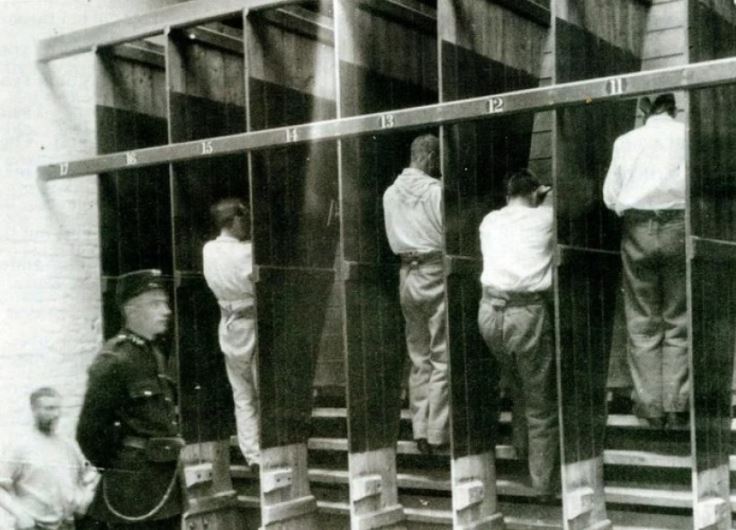
Some, like the mill at Coldbath Fields Prison in London (pictured below), were fitted with partitions so that prisoners were isolated and could see only the wall in front of them.
There are a number of accounts of how much time prisoners spent rotating the wheel before they got a rest.
An entry in the Encyclopedia Brittanica from 1926 says “[The stepmill] revolved at a rate of 32 ft. per minute. The prisoner worked for six hours each day, three hours at a time. He was on the wheel for 15 minutes and then rested for five minutes. Thus in the course of his day’s labour he climbed 8640 ft.” That’s the equivalent of doing the Empire State Building Run-Up at least seven times.
But with the use of the stepmill as a form of prison punishment lasting for over 80 years in Britain the set up and rules involved obviously varied greatly.
One account says prisoners had to put in between 7 and 10-hour shifts on the mill, depending on the time of year. Another says male prisoners were climbing 10-14,000 vertical feet per day, with prisoners on the mill at Warwick Gaol once clocking an exhausting 17,000 vertical feet over 10 hours one summer. That’s more than half way up Mt. Everest.
Elsewhere it’s said that prisoners, “working in silence, would move from left to right so that the man furthest along could step off to take a break while a “rested” colleague got on at the other end. It worked out at around 12 minutes rest for every 60 minutes of climbing.”
Historian Geri Walton notes that “Each prisoner performed 864 steps and then rested being replaced by another prisoner for 288 steps. This rest period lasted about twelve minutes. After the rest period the prisoner then returned to the treadmill to continue his or her stair climbing punishment for another 864 steps.”
Among those subjected to hours on the mill was the playwright Oscar Wilde. He climbed the endless staircase every day for six months at London’s Pentonville Prison, as part of the two-year sentence he received in 1895.
This form of punishment was banned in British prisons in 1902 for being unduly harsh, but modern gym goers continue the grueling activity regardless.
The seven-time winner of the Empire State Building Run-Up enjoyed a long and hugely successful tower running career. We take a look back through his races and pick out five of his finest moments.
With so many to pick from, we’ve selected the ones that stood out to us. Leave a comment to let us know which others you’d include.
5. 2004 Uptown Run Up, Munich, Germany
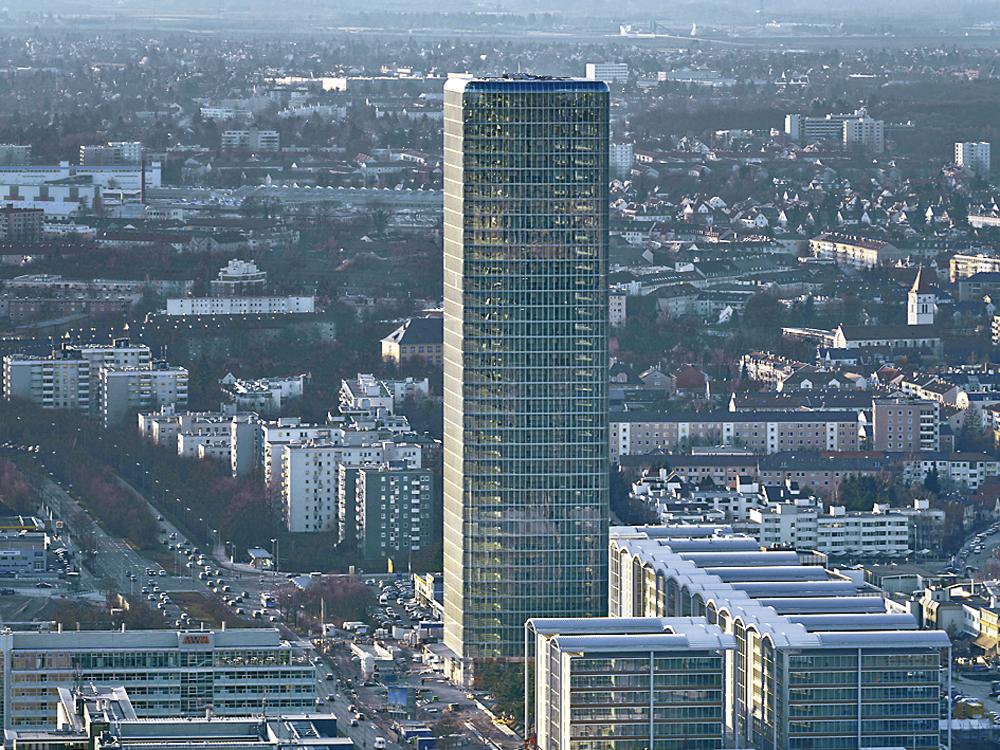
Hochaus Uptown Munchen – site of Thomas Dold’s first tower running victory
Already a mountain running star who’d represented Germany at the World Junior Mountain Running Championships in 2002 and 2003 (where he finished 11th), Dold was still a tower running novice when he took part in the Uptown Run Up on 2 October 2004.
He’d made his stair racing debut the year before, taking sixth place at the highly competitive Donauturm Treppenlauf in Vienna, Austria. But it was in Munich that Dold recorded the first of his 45 career wins.
It was the first edition of the 780-step race, so it probably went unnoticed by many in the world of tower running. But soon they would sit up and take notice of the man from the Black Forest.
It might seem an odd choice to include a race where Dold finished second as one of his ‘top moments’, when he has 40+ wins to pick from. But there’s a reason.
Dold had stepped away from tower running for the 2015 and 2016 seasons, missing all the big races, including the World Championships in Doha.
Many thought they probably wouldn’t see him race again. Then in 2017 he returned for three races on the Vertical World Circuit: Tower 42 in London, Tour First in Paris and One World Trade Center in New York.
He finished second in London (to Piotr Lobodzinski) and would later take a controversial joint-first in New York alongside Australia’s Darren Wilson.
But it was the race up the 954 steps of Tour First in Paris that really stood out. 2015 world champion Piotr Lobodzinski clocked a new course record of 4:42 at the event, but the returning Dold finished just five seconds behind him.
14 years after his tower running debut, and following a two-year layoff, the brilliant Dold proved he could still hold his own with the rest of the best in the world.
3. 2012 European Championship final, Frankfurt, Germany
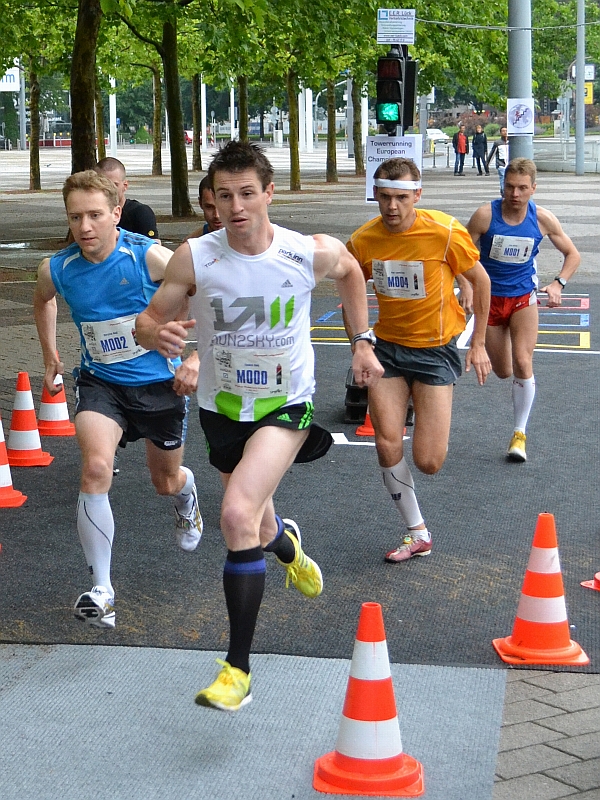
Thomas Dold leads the finalists into the stairwell at the 2012 European Tower Running Championships
A seven-time Empire State Building Run-Up champion and three-time Vertical World Circuit winner, Dold had a massive target on his back at every race he took part in throughout the 2012 season.
At the final of the European Tower Running Championships at the MesseTurm in Frankfurt, Germany, Dold was facing the best of the new cohort of European stair racers.
The championship event involved one full qualifying run up the tower’s 1,202 steps. Christian Riedl clocked the fastest qualifying time, with Dold taking second. Earlier in the year at the Empire State Building Run-Up 2012, Riedl had finished just eight seconds behind the winning Dold. He was definitely the athlete that could cause Dold the most problems.
In the semi-final the runner’s had to sprint just half way up the MesseTurm. This time Dold evened things out and came out on top.
Could Dold take victory in the final run up the full height of the tower? Christian Riedl, Tomas Celko, Piotr Lobodzinski, Milan Wurst and Viktor Novotny were all looking to stop him.
Below is a short clip taken from inside the building during the final run (click here if embed not working).
Thomas Dold once again proved he was still the best in Europe, pulling away from the field to finish in 6:30, ahead of Christian Riedl (6:53) and Piotr Lobodzinski (7:00).
2. Course record at 2012 Vertical Rush, London, UK
As part of the Vertical World Circuit 2012, Vertical Rush in London attracted a long list of top European tower runners.
Dold was making his debut at the 932-step Tower 42 and was expected to be squaring off with the 2011 winner, Fabio Ruga of Italy, for top honours.
Dold produced a performance for the ages, clocking a course record 3:58.
Eight years on and his incredible record still stands. Only Piotr Lobodzinski has come close to it, clocking 3:59 in 2017.
1. Personal best at 2009 Empire State Building Run-Up, New York, USA
Thomas Dold made the Empire State Building-Run Up his own during his stunning run of victories from 2006 to 2012.
There are plenty of memorable moments to pick from out of his seven wins, but the 2009 event stands out as the best.
The stellar line-up in the lobby included 2007 World Mountain Running Champion Marco De Gasperi from Italy and American Rickey Gates, who had finished just eight seconds behind Dold in 2008.
Both men pushed Dold hard throughout the course, driving him on to a 10:07 finish, the best time he ever ran at the Empire State Building.
But what stands out about this race in particular is what might have been.
Only Australia’s Paul Crake has ever completed the ESBRU course in under 10 minutes, managing it four times during his run of victories from 1999-2003.
But under different circumstances, Thomas Dold may very well have done the same in 2009.
At around the 40th floor (of 86), Dold caught up with the back end of the women’s wave that had set off five minutes before the men.
As a result he had to weave his way through scores of runners as he chased his fourth title.
Thomas Dold weaving his way through the women’s wave on his way to winning the 2009 Empire State Building Run-Up
It’s highly likely that given a clear run that day Dold would have broken the 10-minute mark. Unfortunately, we’ll never know for sure.
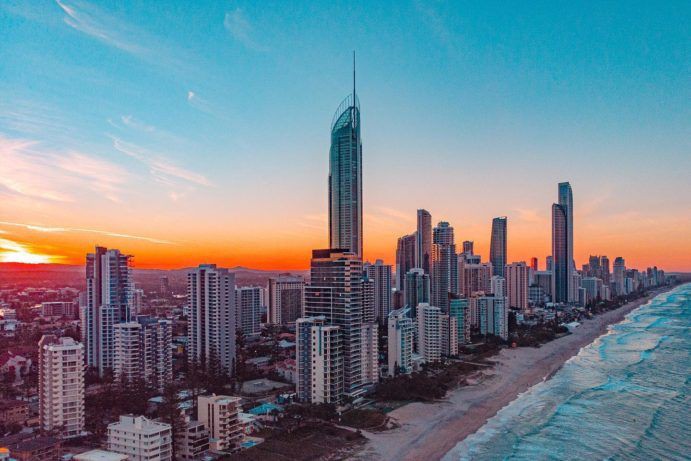
When the Q1 Tower was completed in 2005, it became Australia’s tallest building. Shortly before its towering observation deck was opened to the public, the building played host to a star-studded elite stair race offering $10,000 to the winner. Here’s the story of how it went down.
Measuring 322.5m tall from street to spike, the new skyscraper in Gold Coast, Queensland dwarfed 120 Collins Street in Melbourne, which had been the country’s tallest building since 1991.
With Australia’s long and rich history of stair climbing – the Rialto Run-Up in Melbourne started in 1987 and the Sydney Tower Run-Up in 1990 – it was no surprise that the idea of holding a race up Q1’s 1,821 steps was quickly pitched.
The idea for the event originated during the breakfast radio show The Cage, which was broadcast out of Brisbane by the Triple M network.
Former Australian international rugby player Greg ‘Marto’ Martin was one of the hosts and suggested a stair race be held to celebrate the opening of the Q1 observation deck. Within hours the ball was rolling on getting it organised.
Greg ‘Marto’ Martin in action against the British Lions in 1989
Richard Barker, the general manager of Austereo – the media company then operating Triple M – said: “Triple M is currently talking to Australia’s top athletes to compete in the event which may well become an annual challenge and one we hope to build nationally as comparable to the famous Empire State Building stair race in New York.”
“Based on anecdotal research, the fastest runner is expected to complete the 1,821 stair race to the observation deck in around nine minutes.”
“This compares with the usual mode of transport to be used, one of the world’s fastest elevators, which will do the journey in 43 seconds.”
Austereo and the developers of Q1, Sunland Group, really put a lot behind the event, giving it the exposure it deserved and putting up a huge prize fund to try and attract a wide range of athletic talent.
The prize money on offer was completely unrivalled in stair racing. In fact it was one of the highest paying races of any athletic discipline at the time in Australia.
The winner of the race would take home $10,000 (AUD), second place would receive $5,000 and third, $2,500.
What’s more, in a national first, The Cage breakfast shows from Brisbane, Sydney and Melbourne’s Triple M stations were all set to broadcast live simultaneously from Q1 to celebrate the event.
Triple M – Q1 Run to the Sun
Within a few weeks a line-up of runners was assembled, a mix of elite Australian athletes and media personalities. The selection of athletic talent was huge, with multi-time Empire State Building Run-Up champions alongside long-distance swimming champions, up-and-coming AFL players, international triathletes and emerging track and field stars.
Belinda Soszyn was a highly experienced mountain runner, triathlete and stair runner who had won the Empire State Building Run-Up three times (1994, 1996-97) and the Sydney Tower Run-Up three times (1993, 1995-96).
She’d also won the Australian mountain running championship in 1996 and represented her country at the World Mountain Running Championships.
51 year old Soszyn had hung up her tower running shoes back in the 90s, but the lure of Australia’s new tallest building had pulled her back in.
Belinda Soszyn winning the 1994 Empire State Building Run-Up
Soszyn was set to face off against Vanessa Hill, who had previously placed at the Sydney Tower and Rialto Tower runs.
Although unmentioned in pre-race reports, mountain runner Hubertien Wichers also competed. Whether she was a late replacement for Hill or Soszyn, or an additional entrant is unknown.
Radio personalities Emma Maclean and Brigitte Duclos were the only other women at the race.
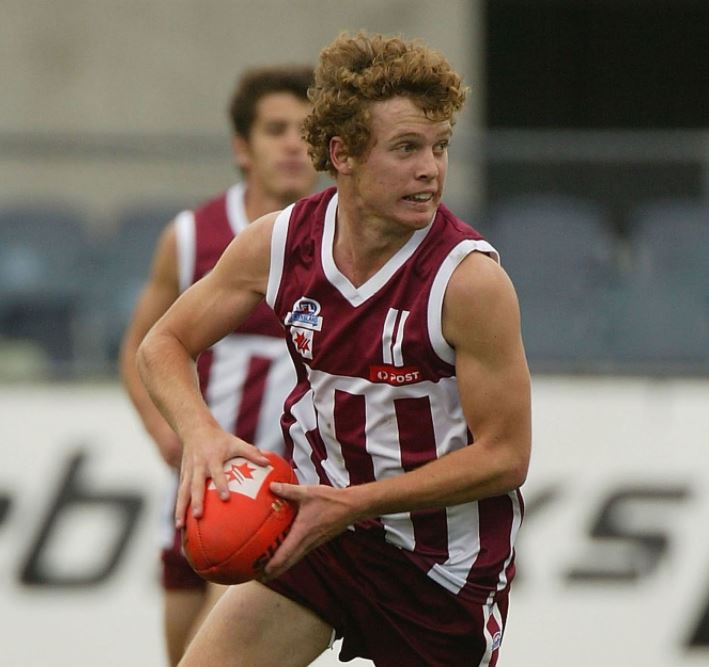
Among the men set to race was young Beau Tanton, a 19-year old AFL player who at the time was playing for Broadbeach AFC on the Gold Coast. Tanton had also represented the Queensland state team a number of times.
Beau Tanton in action for Queensland during the Northern Territory and Queensland AFL Under 18 National Championships in 2004
The experienced Sydney-based tower runner Jeremey Horne had also been invited. A sub-2:30 marathoner, Horne had won the Sydney Tower Run-Up in 2004 and had finished second at the Swissotel Vertical Marathon in Singapore earlier in 2005.
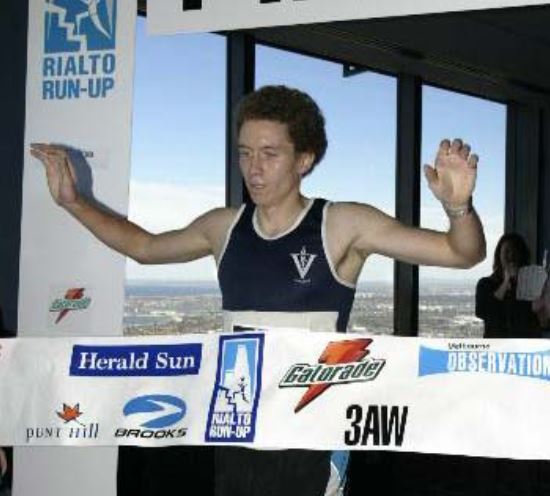
Australian international cross-country skiier Andrew Mock was also there. The 23-year old had won the Rialto Run-Up earlier in the year, so was expected to be in among those chasing for top spot.
Andrew Mock winning the 2005 Rialto Run-Up
From the world of triathlon there was Chris Stanton, who was part of the Australian World Championship team, and the highly-competitive elite Drew Westbrook who had won an ITU Age Group Aquathlon World Championship event in Honolulu a couple of months prior. Ben Holland, another successful age group triathlete, was also on board.
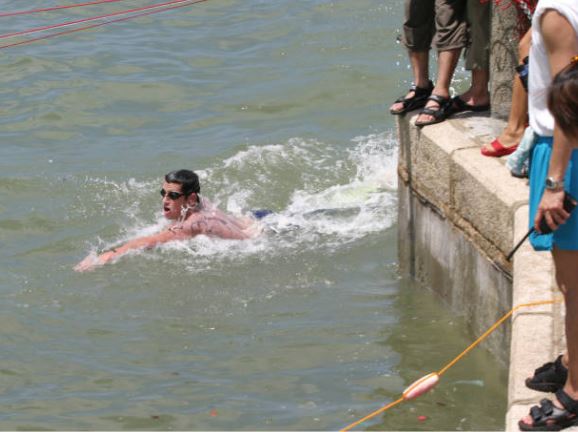
Another athlete new to stair running was Mark Saliba, a long-distance open water swimming champion who’d finished fifth at the 25km Open Water Swimming World Championship in 2004.
Mark Saliba on his way to winning a marathon swimming race in Hong Kong in 2004
The Australian under-23 5km champion Christopher Reeves was signed up too. Fellow Brisbanite Anthony Craig was alongside him. Craig was a middle-distance track star who’d won a silver medal at the Australian University Games.
They were joined by Gold Coast-based Andrew Ferris, who at the time was the best Australian under-23 athlete over 3,000m and 10,000m. He was also the Queensland State Champion over 5,000m.
PJ Bosch, a middle-distance runner from South Australia, was another super-fast young athlete invited to compete.
Others picked to take part in the race included Gerard Gosens, a totally blind elite athlete who had run from Cairns to Brisbane three times; climbed to Everest Base Camp three times and was the Deputy CEO of the Royal Blind Foundation based in Brisbane.
Greg Martin, whose on-air suggestion had gotten the whole event moving, also laced up his running shoes to scale the 1,821 stairs.
2005 Australian and USA Men’s Open Water Ski Racing Champion, Peter Proctor was racing, as was Richard Barnes, a veteran of 15 Sydney Tower Run-Ups who had placed second at the two most recent editions.
Although there was a wealth of young athletic talent at the Q1, it was fully expected that the winner on the day would come from among the remaining four athletes.
Troy de Haas from Gisborne had won a bronze medal at the World Junior Orienteering Championships in 1999 and had gone on to represent Australia at senior championships.
He’d also won the Great Pyramid Race earlier in the year, a 12.2km run up and down Walsh’s Pyramid in Cairns, Queensland.
Although new to tower running, de Haas was predicted to put up a strong challenge to the pre-race favourites.
Troy de Haas at the 2007 Taipei 101 Run-Up
Mountain runner Daniel Green wasn’t well-established on the stairs like some of his rivals at Q1, but the 2000 Australian Mountain Running champion, who’d also finished fifth at the 2004 championships, was a threat, regardless.
The next entrant on the start list had been a star of mountain running and stair climbing for well over a decade.
David Osmond had won the 1994 and 1996 Sydney Tower Run-Ups. He’d also placed second twice at the Empire State Building Run-Up (1995, 1997).
David Osmond (seen here in 1995) was one of the pre-race favourites at Q1 Tower
Winner of the 1996 Australian Mountain Running Championships, Osmond had also been on the podium at the nationals in 2002, 2004 and 2005.
In excellent shape and with the experience required for successful stair climbing, Osmond was certain to be one of the front runners on Thursday 1 December.
Perhaps only one man stood a really solid chance of stopping Osmond claiming the $10,000 prize money, and unfortunately for him that man was the unrivalled king of tower running, Paul Crake.
Five-time winner and course record holder at the Empire State Building Run-Up, Crake was now a professional cyclist with the Corratec-Graz-Cyl team in Austria.
Paul Crake sets the course record of 9:33 at the 2003 Empire State Building Run-Up
Crake was also course record holder at the Sydney Tower and less than a fortnight before the event at Q1 he had won the inaugural race at what was then the world’s tallest building, Taipei 101.
Earlier in 2005 Crake had finished third at the Australian National Road Race Championships.
As expected from a pro cyclist, the Canberra man was in phenomenal shape.
Crake was alerted to the race by a friend in Canberra and headed back to Australia after the Taipei 101 Run-Up to try and score himself some extra funds, having already bagged himself a handsome £3,500 for winning in Taipei.
“I have the strength from cycling to go up the stairs and based on my result in Taipei I should be able to come out and have a good solid run,” Crake told reporters ahead of the race.
“Based on number of steps, number of floors, and the height of the building you can basically work it out but I don’t go into many details. My running time in the stairwell should be 7min 30sec, but you have to run around the block first. A time under 9min is definitely achievable.”
“Stair running is not actually that hard on the legs. It seems to be a lot harder on the lungs”, he added.
Paul Crake (right) on the podium at the 2005 Australian National Road Race Championships
The race began with a mass start and a run around the building before the athletes headed inside and onto the stairs.
By the time they hit the steps, Paul Crake was near the middle of the pack, having lost position on the run in. But with his experience and superior conditioning he was able to slowly work his way towards the front.
Paul Crake (#1, white hat) during the run in at Q1 Run to the Sun
“The most important part of a stair race is to get a good start and the race around the building made that difficult for me,” said Crake.
“I’m not much good at running on the flat these days so when I got into the stairwell there were about seven or eight guys ahead of me. I was a bit apprehensive because it’s hard to judge how far they get in front.”
The Q1 Tower on Australia’s Gold Coast
Troy de Haas was first into the stairwell and held the lead for around two thirds of the way up the tower.
By the 50th floor, Crake had almost reeled him in.
“The Today Show had a camera there and they asked how I was going,” said de Haas.
“I said the bad ‘f’ word and literally I was gone already. From there on, I could hear Paul Crake coming. I didn’t know who it was but I assumed it was him.”
Pre-race speculation was that the winning time would be around the nine minute mark.
Crake surprised everyone by reaching the observation deck in 7:42 to claim the $10,000 winner’s prize.
“There was a bit of elbowing in the stairwell but nothing like what I’ve experienced overseas. I found a few other races more aggressive overseas,” said Crake after his win.
“The Aussies seem to be pretty good. When you go overseas and you have different cultures, different people have different standards of what’s right and wrong.”
“We were rubbing shoulders but I thought it was a fairly clean race. Australians know their manners.”
Second-placed David Osmond (8:15) picked up $5,000 and third-placed Troy de Haas (8:22) won $2,500.
The organisers also had some surprises at the awards ceremony.
The first woman to finish, mountain runner Hubertien Wichers (11:12), was handed a $3,000 cheque and two nights’ stay at Sunland’s Palazzo Versace.
Gerrard Gosens, the blind runner, clocked an impressive 12:04, and was thrilled to be awarded $5,000 along with a holiday at Palazzo Versace by Soheil Abedian, the managing director of Sunland Group which developed Q1.
Abedian hailed Gosens’ determination to overcome obstacles and said he was a true winner, even if he was not the first to cross the finish line.
“What do you mean I didn’t win? I didn’t see anyone in front of me,” joked Gosens, leaving the crowd in stitches.
Despite Austereo’s general manager Richard Barker’s hope before the race that the event would become an annual challenge, it would be 10 years before another race happened at Q1.
The new star of Australian mountain and tower running, Mark Bourne, would win that race in 2015.
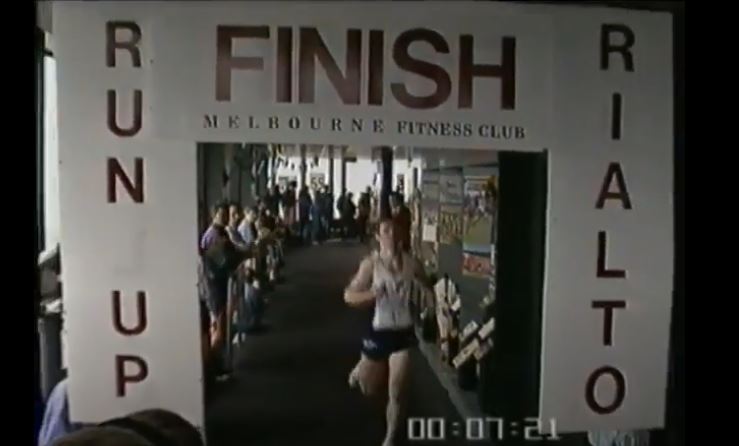
We’re guessing most of you have never seen complete footage from a stair race. In fact, extended footage from any tower run is frustratingly hard to come by. But the wait is now over. OK so it’s 25 years late, but below is video of the full Rialto Run-Up in 1995.
The line up of 40 men at the 1995 edition of the Rialto Run-Up in Melbourne was full of Australia’s very best tower runners. Along with bragging rights in the Australian stair climbing community, the men were also competing for a prize of $1,000AUD.
24-year-old Terry Purcell was back to defend the title he’d won in 1994. Just two years into his tower running career, he’d quickly established himself as the man to beat in Australia and was the pre-race favourite.
Purcell was heading into the race having already pulled off a course record-breaking win at the Sydney Tower Run-Up earlier in the year.
But the man from Geelong would have to put in a seriously strong performance in order to secure back-to-back wins at the 1,254-step tower in Melbourne, as his competition was among the best around.
Phil Griffiths was on the start line. He had won at the Rialto in 1993 and finished second there in 1992. He’d also won the Sydney Tower Run-Up in 1993. Then in 1994 he took third at the Empire State Building-Run Up.
1992 Rialto Run-Up winner Glen Devison was competing too. He’d also finished only two seconds behind Griffiths in the 1993 race, so knew the Rialto course very well.
At the ESBRU in 1993, Devison had made it an Australian one-two as he finished second behind the legendary Geoff Case.
Predicted to be one of Purcell’s toughest rivals on the day was the superstar youngster David Osmond.
David Osmond
Mountain runner Osmond had won the Sydney Tower Run-Up in 1994 on his stair running debut.
As a result he’d earned himself an invitation to the 1995 Empire State Building Run-Up, and when there he’d taken an impressive second place behind Germany’s Kurt Konig.
A pre-race profile on Osmond said he had also enjoyed a stair running triumph in Canberra, which was probably at the inaugural 403-step Telstra Tower Run-Up in 1994.
As if getting to watch that amazing line up of tower runners competing at their peak isn’t good enough, two-time Rialto winner and three-time ESBRU winner Geoff Case is co-commentating on the race.
Now sit back and enjoy the fantastic footage from the 1995 Rialto Run-Up.
Getting to race up the stairs of the Empire State Building just once is a dream for most tower runners. For many it’s a dream that continues to elude them as they fail year after year to secure a coveted place at the world’s longest-running stair race. But for one man it’s become a real-life recurring dream that’s been going for more than a quarter of a century.
When you look back through the long and eventful history of the Empire State Building Run-Up you’d be forgiven for skimming over the event in 1994.
Ran on a shortened course of 80 floors, the men’s race was won by debutant Darrin Eisman (USA), while fellow first-time runner Belinda Soszyn (AUS) took the first of her eventual three victories in New York.
With all the close battles, intense rivalries and record-setting runs that came before and after, 1994 was, in comparison, fairly unexciting.
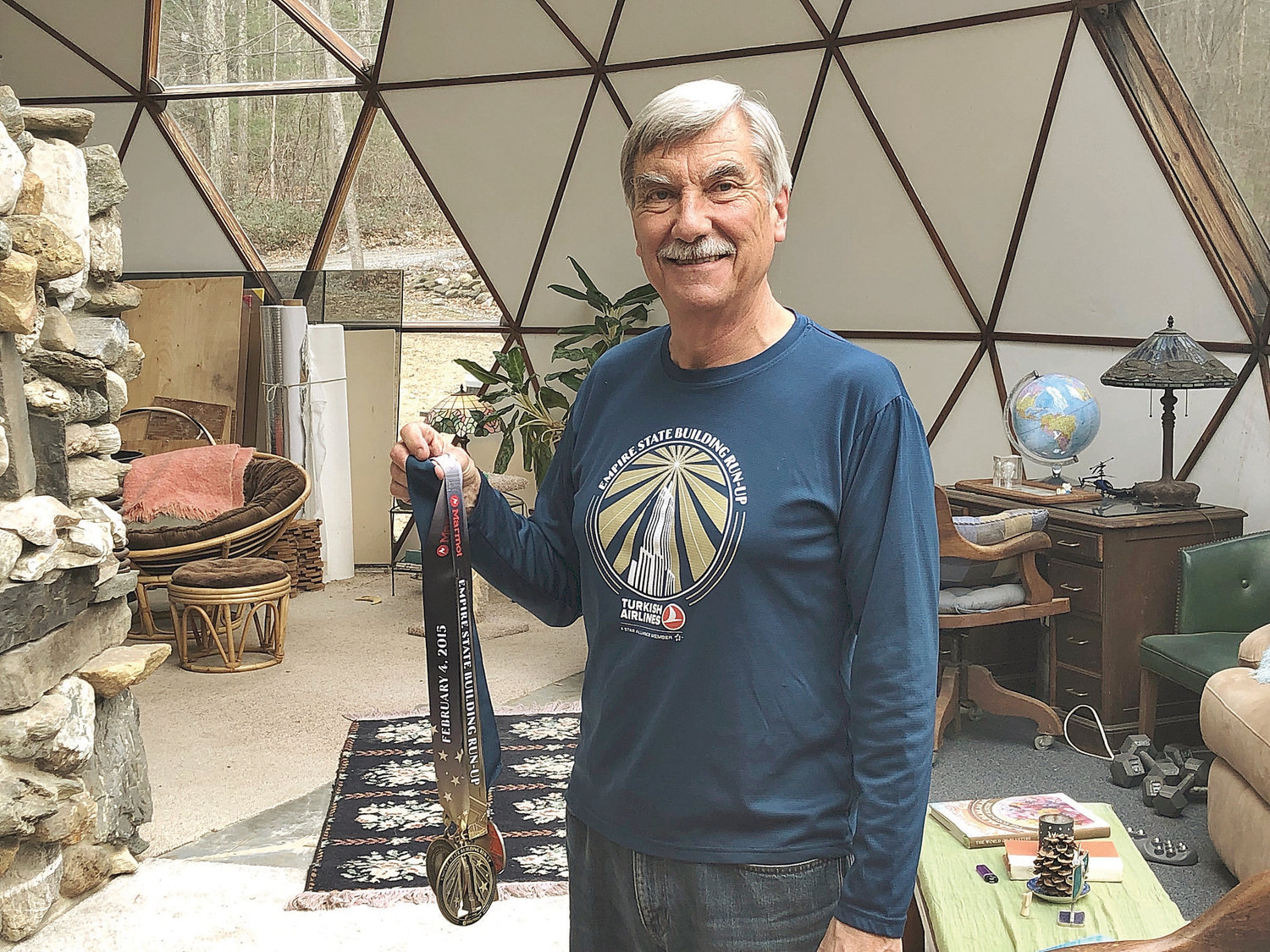
But it was certainly far from unexciting for David Allard, the man who currently holds the record for the most ESBRU appearances. This was the year he made his debut at the famous Manhattan tower.
Darrin Eisman and Belinda Soszyn, winners of the 1994 ESBRU
From novice to veteran
David Allard had only a couple of stair races under his belt when he took part in the Empire State Building Run-Up for the first time in his mid-40s.
In fact he hadn’t run at all until a few years before.
‘I didn’t start running until my daughter had joined the high school cross country team,’ he said. ‘I had never run a step in my life until then.’
Despite his lack of experience, the tower running novice from Great Barrington, MA, clocked a respectable 14:51 on the shortened course in 1994.
A year later he was back to take on the full course of 86 floors/1,576 steps, where he set his personal best of 16:43.
‘It was a simple race at first, with a mass start that begins in the lobby,’ Allard told the Berkshire Eagle back in 2013. ‘We all had to hit this tiny door and then begin our ascent. But a lot of people tried to go too hard, too fast and many ended up holding their chests, slumped to the side of the stairwell by the eighth floor. For me, I set a steady pace and held it.’
‘Years ago you could only pass on the left,’ Allard recalled to the Brattleboro Reformer last year, ‘so you have seven stairs to pass a guy before a landing. Someone hits the landing and just has to turn so it was impossible to pass.’
The elite waves still begin with a manic mass start, but runners in the general wave now set off five seconds apart. With less crowding and mania in the stairwell, it’s a bit easier for Allard to settle into his runs and focus on his technique.
With 26 ESBRU appearances to his name, David Allard perhaps knows the stairs and the race better than almost anyone. So first time tower runners could do worse than listen to some of his advice.
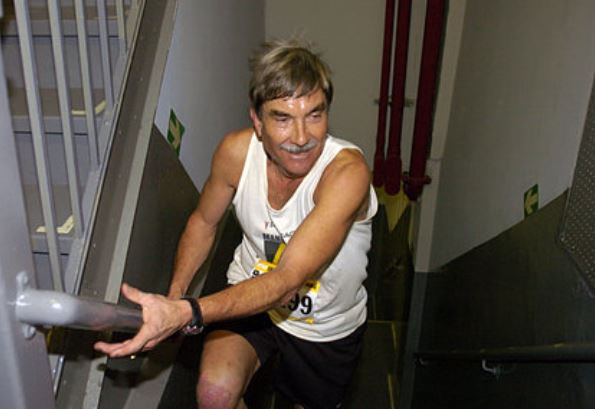
‘It’s a breathing race, not a leg race,’ says Allard. ‘It’s all about holding a steady breathing pattern and using the handrails to carry your momentum.’
‘You bring yourself right to the edge of a heart attack, and you just hold it. The Empire State Building [Run-Up] is not a legs race, it’s a lungs race. The trick with the race is to start at the pace you’re going to maintain.’
David Allard at the 2008 Empire State Building Run-Up
His top five tips?
‘(1) Don’t go out too fast; (2) Take the stairs two at a time; (3) Use the hand rails; (4) When someone wants to pass you in the stairway, get out of the way; and (5) Smile at the end.’
The payoff at the top will make all your hard work worthwhile, Allard promises.
‘It’s the most beautiful ending to a race because you have to run one last lap around the observation tower and you get to see all of New York ahead of you. It’s so exhilarating, there’s no other feeling like that.’
David Allard crosses the line at the 2015 ESBRU
TV presenter Kelly Ripa took part in the race in 2013 and she got to meet David Allard before she set off on her run.
You can see their brief exchange at the Empire State Building in the video below (starts at 1:40).
Allard’s rivals for The Streak
‘The streak is a really strange thing because it has zero value,’ says Allard. ‘Yet to the person that holds the streak it has enormous value.’
Hot on his heels for the record for most appearances at the Empire State Building Run-Up is a well-known tower runner from New York, Stephen Marsalese.
Marsalese made his debut at the Empire State Building in 1996 and has competed in every race there since, bringing his current number of appearances to 24.
With 15 or so years age difference between the two men, it’s likely the younger Marsalese (if he continues to be invited to the the ESBRU) will eventually outlast Allard.
David Allard and Stephen Marsalese
But the evergreen, four-time winner Cindy Harris (nee Moll), who currently has 22 appearances to her name and is still competing at the very top, could well pass both men out in the coming years.
But Allard has no plans to call time on his fantastic run at the ESBRU any time soon.
‘I hope to do this into my nineties—I’ll crawl up the stairs if I have to’, he told TimeOut.
The Empire State Building Run-Up (ESBRU) was first held in 1978. Since then each race has been packed full of exciting moments, surprises and disappointments.
Here are five of our favourite Empire State Building Run-Up moments. Feel free to share yours in the comments below.
1979: Last to the lobby, first to the top
The second edition of the Empire State Building Run-Up took place at 10:30am on the morning of Thursday 15 February 1979.
At 9:40am the eventual winner was still sitting at the desk in his Manhattan office at 58th Street and Park Avenue, a mile-and-a-half from the Empire State Building.
Financial analyst Jim Rafferty had earned his invite to the ESBRU off the back of some solid road running performances in 1978. He was 25th at the New York Marathon in October and then in December he’d finished fourth in a 30km race organised by the New York Road Runners, the same organisers of the ESBRU.
Rafferty was one of just 20 men and four women that had been invited to the second edition of the new stair running event. But on the morning of the race he was in two minds about taking part. He was due to race in the Boston Marathon in April and was worried about picking up an injury in the unusual and novice event.
With less than an hour before the start, still sitting at his desk, he seemed to have settled on not running. But then he had a sudden change of heart.
‘I was worried about twisting an ankle on the stairs’, he said. ‘But then I thought it’d be a lot of fun. It’s not your everyday competitive event, you know.’
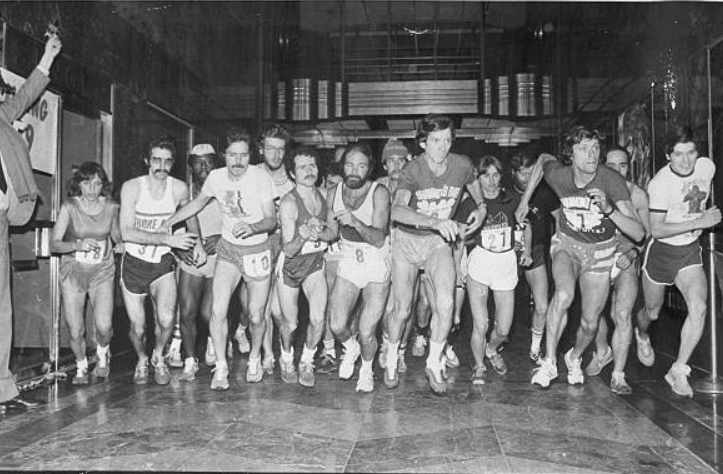
At 9.45am Rafferty asked his boss if he could have a couple of hours off, jumped in a cab and reached the building just before the start. You can see him on the far right in the picture above.
In the race, he took the lead fairly on and held it to the finish line, crossing it in a new record time of 12:19.
Eight weeks later Jim Rafferty set a personal best of 2:18.55 at the Boston Marathon.
Heading into the 1987 race, Al Waquie already had four ESBRU wins to his name.
Typically he’d have been a firm favourite for a fifth win on the trot. But a knee injury sustained in July 1986 had prevented him from running properly for seven months.
As he and others toed the line in the first of two waves at the 1987 ESBRU, nobody knew what sort of shape Waquie was in.
Alongside him was the emerging stair climbing star from Indianapolis, Joe Kenny, who had won the 1986 Bop to the Top in his home city, plus other stair races in the USA.
Despite getting a good start, Waquie was already struggling by the 20th floor. Kenny passed him at the first crossover and began to pull away, looking set to put an end to Waquie’s winning streak.
But Waquie had different ideas. He powered on, while up ahead Kenny and another climber began to fade. With 14 floors to go, Waquie finally caught up with them and showed them both exactly why he was a four-time champ.
‘He just blasted by me at the 72nd floor’, Joe Kenny said. ‘I think he stayed back at the start and saved his big move for the end. He really knows those stairs’.
Waquie’s gutsy fifth win would be his last at the Empire State Building Run-Up.
With one eye on a pro cycling career, Paul Crake was ready to call time on his incredible run at the Empire State Building when he got set to race on Tuesday 4 February 2003.
Unbeaten in each of his four appearances at the ESBRU, Crake had become the first man to run the course in under 10 minutes when he clocked 9:53 in 2000. The following year he shocked the stair running world again by winning in 9:37.
But Crake had saved his best for last. His final run at the iconic New York tower was magisterial. He set an untouchable new record of 9:33.
‘To win five years in a row has been fantastic. It’s been a dream run,’ said Crake.
When asked why he kept returning year after year even though the race has no prize money, he responded: ‘It’s for the trophy, the honour and the glory.’
Already a two-time winner at the ESBRU, and the only woman to have run the full 86 floor course in under 12 minutes, Andrea Mayr was the firm pre-race favourite at the 2006 event. There was no suggestion that she might be beaten, instead the talk was all about how much faster could she go.
Three months before the ESBRU, Mayr had won the inaugural Taipei 101 Run Up in a time of 12:38 (a record that still stands). She was in outstanding form coming into the race.
The Austrian ran the course virtually unchallenged. She finished in an incredible new course record of 11:23, which was fast enough to place her fifth overall. Her record still stands.
2006 was the last time Mayr ran at the Empire State Building. Seven months later she went on to win her first World Mountain Running Championship title and began another history making run in that athletic discipline.
Although in February 2009 Suzy Walsham was a little over two years into her tower running career, she’d already established herself as the one to beat in Manhattan. She was going for her third straight ESBRU.
In 2007 and 2008, Walsham had been joined on the podium by Cindy Harris and Fiona Bayly. Both were once again expected to be among Walsham’s toughest challengers. Debutants Jessamy Hosking (AUS) and Daniela Vassalli (ITA) were also anticipated to be in the mix for the top spots.
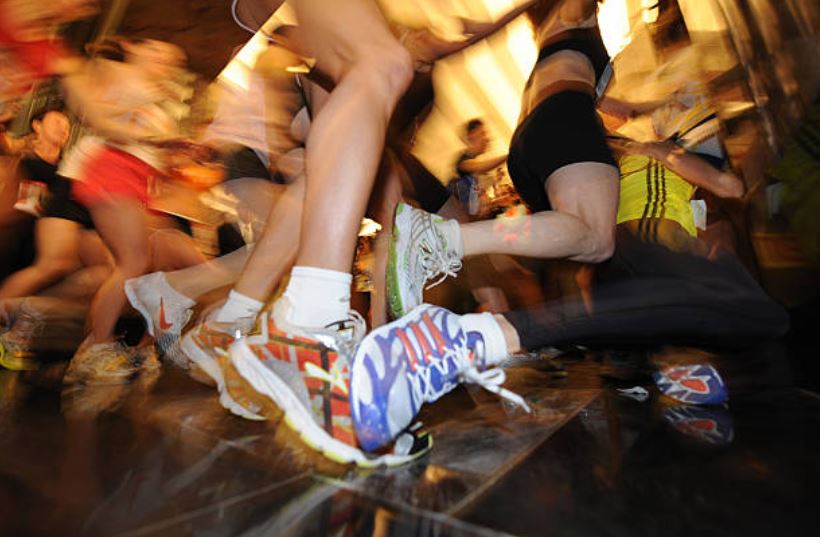
When the claxon went off in the lobby, the mass of women dashed headlong for the door.
Running side-by-side towards the entrance to the stairs, Walsham and Vassalli were battling for space.
Nearing the door, it seemed like Walsham was going to pass the Italian, but Vassalli had other ideas. She reached up and shoved the Australian, causing her to lose her balance and smash face first into the stone door frame. You can see Walsham’s falling figure (yellow top) in the picture above.
Bruised and bashed with the front runners now well ahead, Walsham found herself in around 30th place by the time she had got off the floor and onto the stairs.
What followed was one of the defining moments in Walsham’s amazing ESBRU story.
She started picking off runner after runner, slowly pulling in the leaders. By the 50th floor she caught Vassalli. Hosking and Harris were still up ahead.
At the 65th floor Walsham took the lead and then held it all the way to the top. Her knee injured and her face swollen, she crossed the line in obvious pain just 13 seconds ahead of Vassalli who had surged into second place.
That comeback victory in 2009 was the slowest of the 10 ESBRU races Walsham would eventually win, but without doubt it is one of the best.










 Tower Running UK